Thursday, July 24, 2008

Lambeth Bishop March to End Poverty

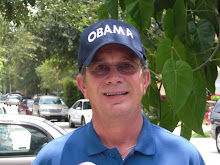
Here is a picture of Larry and myself taken with Bishop Frade in Miami last November.
Although marching to end poverty, sexuality issues were addrssed through sings of some of the marchers. I am so proud of my Bishop, Bishop Leo Frade. Here is the last sentence of this report:

The sexuality controversy roiling the Anglican world was not absent, with one protestor, the Rev. David Braid, holding a sign "Jesus never ordained sodomites. Neither should the church. Hitler was a sodomite."

Bishop Leo Frade of Southeast Florida had wrapped a rainbow flag around his sign because, he said, "when we talk about justice and mercy, we need to remember that gay and lesbian persons are discriminated against by the church and the government."

[Episcopal News Service, London] Anglican bishops and their spouses demonstrated on July 24 in support of poverty reduction worldwide, walking in purple cassocks and native dress past symbols of British power such as the Houses of Parliament and the prime minister's residence at Downing Street.

Archbishop of Canterbury Rowan Williams and other Christian and interfaith leaders were at the head of the march, walking behind a banner reading "Keep the Promise/ Halve Poverty by 2015," references to one of the United Nations' Millennium Development Goals for global progress.

The one-hour march, which created a river of violet down Whitehall Road, ended at Williams' residence, Lambeth Palace, across the River Thames from the seat of Great Britain's government.

Prime Minister Gordon Brown, speaking to the bishops at Lambeth, called the march "one of the greatest demonstrations of faith this great city has ever seen."

Brown said wealthier nations are not moving fast enough to meet the development goals. "At our current rates of progress," they will not be met by 2015 deadline set in the MDGs. Some, he said, will not be met for 100 years if the rate of progress is not increased.

"I say to you that the poor of the world have been patient but 100 years is too long for people to wait for justice and that is why we must act now. We know that with the technology we have, the medicine we have, the science we have, it is the will to act that must be found," he said.

Williams noted that "unless we address this great gulf between human beings, we cannot expect a future of stability or welfare. As the world grows smaller, the truth is that the suffering and the needs of anyone in our global community is going to be the suffering and needs of everyone in our global community. This is not and should not be a surprise to those of us who hold the Christian faith and who have believed for 2,000 years that when one part of the body suffers, all suffer."

Flanked by Christian and other faith leaders including Cardinal Cormac Murphy-O’Connor, Rabbi Sir Jonathan Sacks and Sir Iqbal Sacranie, representing Islam, Williams said that the goal must be "to give to each person what they deserve in the eyes of God, not what they deserve because of their prosperity but what they deserve because they are made in God's image and demand our respect, our love and our service without qualification -- that is justice."

Referring to an emergency session of the UN General Assembly on the global food and fuel crises, set for Sept. 25 in New York, Brown told the rally "we need a march not just to Lambeth, we need a march also to New York."

"I ask you to go back to your countries and I ask you to ask your governments and I ask you to ask all of civil society to tell people that on September 25 we have got to make good the promises that have been made, redeem the pledges that have been promised, make good the Millennium Development Goals that are not being met," he said.

Brown asked the crowd to join him in asking their governments to commit to three goals. The first is that by 2010, 40 million more children would be in school "on the road to every child being in schooling by 2015."

The second pledge would be to train medical workers and provide them with the equipment "to eradicate polio, tuberculosis, malaria and diphtheria, then go on to eliminate HIV/AIDS in our generation."

The third is to allocate $20 billion in food aid "and not for only food aid but to give people the means -- free of the old agricultural protectionism -- to grow food themselves with help from our countries to develop a green revolution in Africa."

Speaking after Brown, Hellen Wangusa, the Anglican Observer at the UN, said that she would bring word of the Walk of Witness to the UN meeting.

The march was organized in partnership with Christian social justice advocacy group Micah Challenge UK. Board member Paul Cook said the organization hopes to see "a roadmap" and a "global action plan" for getting back on track with the development goals' timeline.

With a slight breeze blowing off the Thames, the demonstrators enjoyed a perfect sunny summer day. Many of the bishops’ wives wore dresses and hats or such native costumes as saris, ready for a garden party scheduled to take place in the afternoon at Buckingham Palace. Occasionally, there was a burst of hymn singing, with "We are marching in the light of God" being one selection.

Some bishops had customized the backs of their signs: one read "Derby 4 justice" and another, "British Columbia 4 justice and peace." The march passed statues of British military leaders: Field Marshal Earl Haig, Field Marshal the Viscount Slim and one monument simply for "The Women of World War II." As they passed the statue of Oliver Cromwell outside Parliament, the deep tones of Big Ben began to toll the hour at eleven o'clock.

The one-hour march stopped traffic on one of London's busiest streets, with tourists gazing from the top of double-decker sightseeing buses and passersby snapping photos.

As the 600 bishops and their spouses assembled before the walk on a side street of government offices, workers hung out of the windows, taking pictures.

Bishop Henry Parsley of Alabama, who took advantage of several pedicabs hired for the marchers who found walking difficult, noted that his diocese contributes to Millennium Development Goal work. The march, he said, "is an opportunity to make a visual statement of support for the goals." Although the United States is generous in the area of foreign aid, its environmental record is poor, he said, adding that he hoped the march "gets translated back to (President) George Bush's office so he sees the bishops of the world care a great deal (about such issues)."

Bishop John Gladstone, Moderator of the Church of South India in S. Kerala, an ecumenical partner, said that in his area, "there are four million people who are very economically disadvantaged. The local church and diocese generate employment, attempt to attend to health care and to alleviate poverty through different ways."

Kallistos of Diokleia from the Orthodox Church  Patriarchate in Constantinople, dressed in black robes and headdress and wearing gold icons around his neck, stressed the universality of poverty. "Anglican problems are our problems," he said. "We are here today to bear witness against worldwide poverty so many people who are pleading for a fair distribution of wealth between the rich and poor can be heard."

The Rev. Dr. Michael Battle from Los Angeles, a chaplain at the Lambeth Conference, referred to Queen Elizabeth’s garden party later in the day and said the march “will show bishops can be relevant for the whole world. This is the first time they (the Lambeth Conference bishops) have done this. Usually it’s [just] high tea with the Queen.”

Bishop George Councell of New Jersey noted the so-called "Walk of Witness" was especially important since "later in the afternoon we have this privileged access to Buckingham Palace. I pray that we'll carry the hunger of the world and our own hunger for justice with us."

Bishop Ezekiel Malaandit of the Diocese of Bor in Sudan, whose primate earlier in the conference criticized the U.S. church's inclusive stance on homosexuality, said that "We are here to help people, to be supportive, to show we are one communion. Changing minds, sharing ideas and experiences, talking and working together like this we benefit from one another."

Bishop David Beetge of the Diocese of Highveld in South Africa said the development goals have a high profile in his area. "On HIV/AIDS, we've got 73 projects going: orphans and vulnerable children, early developmental childhood centers, reflecting on gender issues. We are trying to embrace the MDGs although there are eight different ones in a very holistic way to bring about a humanity and compassionate society which reflects the very heart of Christ."

Among the passersby watching the march, Thomas Pope said he traveled from his farm in Dorset to see the parade and applauded the bishops as they passed. "They have tremendous courage to stand out and walk down Whitehall in such a dignified way. I heard the archbishop (of Canterbury) speak on the wireless (radio) this morning and thought I would come and see it."

Another spectator, Jane Nelson, said she had come "to be in solidarity with the Episcopal Church of the USA. They have set a courageous example and I think it is sad that one of their duly elected bishops was not invited to Lambeth."

The sexuality controversy roiling the Anglican world was not absent, with one protestor, the Rev. David Braid, holding a sign "Jesus never ordained sodomites. Neither should the church. Hitler was a sodomite."

Bishop Leo Frade of Southeast Florida had wrapped a rainbow flag around his sign because, he said, "when we talk about justice and mercy, we need to remember that gay and lesbian persons are discriminated against by the church and the government."

Wednesday, July 23, 2008

American Pastor Addresses Anglican's Lambeth Conference

This Lambeth update report came from the Walking with Integrity Lambeth update.
After reading the update I wanted to learn more about Dr. McClaren
so googled him and after the article, I have posted his biographical information obtained from his website,  brianmcclaren.net.
 
ARCHBISHOP OF CANTERBURY INVITES PARADIGM SHIFTER BRIAN McLAREN TO SPEAK TO WORLDWIDE BISHOPS ABOUT EVANGELISM
by Louise Brooks, Integrity's Lambeth Press Officer . “Three or four years ago, I spied a book with an interesting title in a bookstore”, explained the Archbishop of Canterbury, as he introduced Dr. Brain McLaren, a nondenominational Maryland pastor and elder statesman of a movement called the “Emerging Church”. That book was titled, A GENEROUS ORTHODOXY “It had the longest subtitle I’ve ever seen,” he continued. (Why I Am a Missional, Evangelical, Post/Protestant, Liberal/Conservative, Mystical/Poetic, Biblical, Charismatic/Contemplative, Fundamentalist/Calvinist, Anabaptist/Anglican, Methodist, Catholic, Green, Incarnational, Depressed-yet-Hopeful, Emergent, Unfinished CHRISTIAN.) “After I finished his book, I knew he was someone I wanted to speak to us here tonight.” . The title for McLaren’s talk this particular evening was somewhat shorter but still provocative: CHANGING CONTEXTS: BREAKING OPEN OUR MODELS OF EVANGELISM. His targets for this new model of evangelism are “those who never show up in churches; those who are created in the image of God but have never known the spirit of God.” . To a nearly SRO audience in the “big blue tent”, McLaren announced to the crowd, “We are called to create a new understanding and a new evangelism. Are we making disciples of reconciliation and transformation on earth.? Or, are we just selling tickets to heaven?” McLaren proposed that the Gospels gave us information on how to get to heaven but little information on how to live on earth. “On earth”, he pointed out, “is what The Lord’s Prayer talks about.” . McLaren defines evangelism as an outward mission and believes it is the only hope of saving the church from irrelevance. He urges the bishops and their spouses to be part of a paradigm shift where they preach a gospel of reconciliation and transformation by Jesus, rather than a gospel of “evacuation” which only includes some. When asked a question about how young Christians are affected by the decision to exclude Bishop Gene Robinson, McLaren said it is important to see how Christians love each other when they disagree. He also suggested that the issue of homosexuality be dealt with as missiological concern rather than a theological concern. McLaren’s greatest hope is that Christianity will become a movement rather than a religion. “What would happen if we rediscovered and reprioritized our mission to be the hands and feet and eyes and ears of Jesus in the world? What would happen if every Christian was a beacon of light and hope, not judgment? What would happen if we transformed the world with the message and teachings of Jesus Christ?” What would happen? Can our bishops make that happen? Only time will tell.
_______________________

Brian D. McLaren

Brian D. McLaren is an author, speaker, pastor, and networker among innovative Christian leaders, thinkers, and activists.

He is a frequent guest on television, radio, and news media programs. He has appeared on many broadcasts including Larry King Live, Religion and Ethics Newsweekly, and Nightline. His work has also been covered in Time (where he was listed as one of American's 25 most influential evangelicals), Christianity Today, Christian Century, the Washington Post, and many other print media.

Born in 1956, he graduated from University of Maryland with degrees in English (BA, summa cum laude, 1978, and MA, in 1981). His academic interests included Medieval drama, Romantic poets, modern philosophical literature, and the novels of Dr. Walker Percy. In 2004, he was awarded a Doctor of Divinity Degree (honoris causa) from Carey Theological Seminary in Vancouver, BC, Canada.

From 1978 to 1986, McLaren taught college English, and in 1982, he helped form Cedar Ridge Community Church, an innovative, nondenominational church in the Baltimore-Washington region (crcc.org). He left higher education in 1986 to serve as the church's founding pastor and served in that capacity until 2006. During that time, Cedar Ridge earned a reputation as a leader among emerging missional congregations.

Brian has been active in networking and mentoring church planters and pastors since the mid 1980's, and has assisted in the development of several new churches. He is a popular conference speaker and a frequent guest lecturer at seminaries and denominational gatherings, nationally and internationally. His public speaking covers a broad range of topics including postmodern thought and culture, Biblical studies, evangelism, leadership, global mission, spiritual formation, worship, pastoral survival and burnout, inter-religious dialogue, ecology, and social justice.

McLaren's first book, The Church on the Other Side: Doing Ministry in the Postmodern Matrix, (Zondervan, 1998, rev. ed. 2000) has been recognized as a primary portal into the current conversation about postmodern ministry. His second book, Finding Faith (Zondervan, 1999), is a contemporary apologetic, written for thoughtful seekers and skeptics. His third book, A New Kind of Christian (Jossey-Bass/Leadership Network, 2001) further explores issues of Christian faith and postmodernity, and won Christianity Today's "Award of Merit" in 2002. His fourth, More Ready Than You Realize: Evangelism as Dance in the Postmodern Matrix (2002) presents a refreshing approach to spiritual friendship. A is for Abductive (coauthored with Dr. Leonard Sweet, Zondervan, 2002) and Adventures in Missing the Point (coauthored with Dr. Anthony Campolo, Emergent/YS, 2003) explore theological reform in a postmodern context, and a sequel to A New Kind of Christian, entitled The Story We Find Ourselves In (Jossey-Bass, 2003), seeks to tell the Biblical story in a new context. He is one of five co-authors of Church in the Emerging Culture (Emergent/YS, 2003).

His 2004 release, "A Generous Orthodoxy" (Emergent/YS/Zondervan), is a personal confession and has been called a "manifesto" of the emerging church conversation. The conclusion to the A New Kind of Christian trilogy was released in 2005, entitled "The Last Word and the Word After That" (Jossey-Bass).

"The Secret Message of Jesus" (W, April 2006), explores the theme of the kingdom of God in the teachings of Jesus. "This book was written for a broad audience," he explains, "from the spiritual-but-not-religious to Christian pastors and leaders. Everything I've written to this point has been a preparation for this book."

His books have been or are being translated into many languages, including Korean, Chinese, French, Swedish, Norwegian, and Spanish. He has written for or contributed interviews to many periodicals, including Leadership, Sojourners, Worship Leader, and Conversations. Many of his articles are available at www.brianmclaren.net. He is also a musician and songwriter.

He is on the international steering team and board of directors for emergent, a growing generative friendship among missional Christian leaders (www.emergentvillage.com, www.emergent.info). He is also active in global networking among emerging leaders (amahoro.info).

He serves as a board chair for Sojourners/Call to Renewal (sojo.net), and is a founding member of Red Letter Christians, a group of communicators seeking to broaden and deepen the dialogue about faith and public life. He is also a board member for "Orientacion Cristiana," and formerly served on the boards of International Teams (www.iteams.org) in Chicago, Mars Hill Graduate School in Seattle (mhgs.edu), and Off The Map (off-the-map.org). He has taught or lectured at several seminaries in the U.S. and abroad.

Brian is married to Grace, and they have four young adult children. He has traveled extensively in Europe, Latin America, and Africa, and his personal interests include ecology, fishing, hiking, music, art, and literature.

Tuesday, July 22, 2008

Estelle Getty Passes On

Estelle Getty passed away today. She suffered from Lewy Body dementia.
Millions of Americans loved watching her on the Golden Girls. 
On December 31, 1984, a friend and I flew from Houston where I was living at the time and saw Estelle Getty in a play starring her and Harvey Firestein. I can't remember the name of the play but she was SO funny.
She will be missed.

Press Release: the Rev. Susan Russell Pres. of Integrity

As the majority of bishops attending the Lambeth Conference settled into daily Bible Study, Indaba groups and conversations across differences it was made clear that at least a percentage of the purple shirts on the Canterbury campus are focused on conflict rather than collegiality. Having issued statements on the ongoing genocide in Sudan and the ongoing discussions on human sexuality in the Anglican Communion, it was not genocide but sexuality that was the focus of the Sudanese primate's briefing to the media. In the press conference on Tuesday afternoon, the Primate of the Sudan (the Most Rev. Dr. Daniel Deng Bul) called for the resignation of the Bishop of New Hampshire, declaring in the statement released ahead of the press conference that he had come to the Lambeth Conference “to take the necessary steps to safeguard the precious unity of the Church.” When asked about ministering to the gays and lesbians in his province, the archbishop declared that he did not think there were any homosexuals in the Sudan as “none had come forward.” And when queried about his position on the ordination of women to the priesthood and episcopate said he “believed in women priests and bishops because they were human” – leaving listeners to wonder if the inference was that homosexuals were not. The fact that there are those within the communion who think the Bishop of New Hampshire should resign is not news. Indeed, there have been calls for his resignation since the day he was elected. What is news is that the Archbishop of the Sudan helped make the case on Tuesday that the schism facing the Anglican Communion is the direct result of hard-line reactionaries who will stop of nothing short of compliance with their narrow, exclusionist agenda as their criterion for being in communion. What is news is that a bishop in the Church of God would deny the existence of gay and lesbian member of his province despite the call for listening to the experience of homosexual people throughout the communion. On Wednesday evening, Integrity USA will present a preview screening of the documentary Voices of Witness: Africaas one of the Lambeth Conference Fringe Events. Everyone is welcome – most particularly Archbishop Deng Bul. We would love to share with him the witness of gay and lesbian Africans who are not only fully human but fully loved by the God who created them in love.  -- Posted By SUSAN RUSSELL to Walking With Integrity at 7/22/2008 01:55:00 PM

Anglican Chaos at Lambeth

Ruth Gledhill, religious writer for the London Times wrote this entry in her blog today.
Ruth tends to be rather dramatic with her stories, so I am awaiting word from other press releases to determine if Ms. Gledhill's reporting is indeed accurate.
Gordon
Lambeth Diary: Into the 'Miry Pit' of Chaos.

It's about a hundred degrees and getting hotter in the Big Top at Lambeth but the £1 million black hole in the budget at the Lambeth Conference means they can't afford air conditioning. Expect fainting bishops to be ferried out by ambulances any moment now, if they don't start shooting each other first. The press conference this morning was a farce. Excommunications officers declined to comment on who is here for reasons of 'security' but declined to say what the 'security' issues were. Apparently there are some Nigerian bishops at the conference but we are not allowed to know who they are. Even the totally harmless and innocuous Church Press here are  being denied access to the evening Eucharists. As for me, I was told yesterday that it was worth applying to attend the afternoon indaba groups. Today there is one called 'Never say No to Media',  led by Rev Dr Joshva Raha, tutor at the Centre for Mission Studies at Queen's, Birmingham. I applied and they said no.

The conference is falling apart and it is only day two of official business. The Sudanese bishops, who were, astonishingly, stationed as Salisbury with the US Presiding Bishop and her team before the conference, have almost derailed the whole thing by virtually calling for Gene Robinson's resignation. One of their two statements today is here.

The funding crisis is more severe than we realised. A senior source has told me that the conference is up to £2 million in debt, and they are at a loss of how to meet this. 'We can't pay for it,' he told me, looking desperate. The prospect of the bailiffs turning up at Lambeth Palace to requisition some of those lovely old paintings of previous Archbishops is to unbearable for words. The Church Commissioners cannot help out because their trust deeds restrict financial aid to the English church only.

An emergency meeting has been called for the Commissioners and the Archbishop's Council immediately after the conference. Will TEC be handed the begging bowl? A bit embarrassing, isn't it, if on the one hand the conference organisers say, your legally elected bishop cannot come. And then on the other, they say: 'Help! Save us from our debt!'

This is why, I understand, we are all sweating like the proverbials. The big blue top where the bishops have their plenaries is, literally, hotter than hell itself. The prospect of air conditioning was explored, but when the estimate came in it was turned down. They just couldn't afford it.

And of course think of all that accommodation that has been booked. More than 230 rooms, presumably paid for, and lying empty. What a shame.

Poor Rowan Williams is trying his best, as we report. The retreat went well, the Archbishop seemed even to be beginning to enjoy himself. There are some genuinely good ideas for covenant and canon being worked out here. The trouble is, too many of the bishops don't want to know. It really is increasingly difficult to see how the Archbishop is going to resolve this mess. As he said yesterday, it will take nothing short of a miracle, and none knows how many Anglican bishops still believe in those.

Anglican Archbishop of Sudan Wants BP Gene to Resign

Archbishop of the Sudan, the Most Rev. Dr. Daniel Deng Bul wants Bishop Robinson to resign...
so what's new about that? Most of the global south wants that to happen.
My words to Bishop Robinson would be, "hang in there Bishop Robinson. A lot of us are holding you up in our prayers and think you're doing a great job."
Gordon
From anglican-mainstream.net

Lambeth Report #6 Tuesday afternoon, July 22, 2008

Cherie Wetzel reporting from Canterbury, England

We have just had a briefing with the Archbishop of the Sudan, the Most Reverend Dr. Daniel Deng Bul.  He informed the press room this morning that he would come and speak with us, since the Anglican Communion News Bureau running this conference, would not schedule a time for him to address the press. 

The archbishop is young – I would guess that he is in his 40’s.  He is very articulate and has an earned Ph.D.  By his own admission, he has been an Anglican since he was a very small child.

His words are responses to questions asked.  I think the questions are self-evident.

“Gene Robinson should resign for the sake of the Church and the entire Anglican Communion.  We are pleading with them (the others at this conference) for the Anglican World, to not throw that away.

“We do not want to throw any people away, either.  But we are here to determine how to remain united.  That begins with forgiving one another for errors made.  Gene Robinson is an error.  The American church has not admitted they are wrong and we cannot forgive them until they do.

“I do not see a way out of these problems with the Indaba groups.  The main issues have not been touched.

“300 bishops are not here because of Gene Robinson.  Can he not resign to allow them to come?  Why has he not done that? 

“He is a human being and we are not throwing him away but the norms of the Anglican Communion have been violated.  The question is not if Gene Robinson comes but what are we being challenged to do by GAFCON?”

“Let the Anglican world be united and be a normal, respected Christian body.” 

“We have not punished the American church yet.  We are asking them to repent.  I am talking about the institutional church in America, no specific bishops.  I am here to speak within the House.  I cannot be silent on this issue; I must speak to the House for the reality I know with my people.  I should not hesitate to be here since I have been an Anglican since I was a child. 

When asked what would happen to the Communion if Robinson did not resign, the archbishop continued, “I cannot predict what will happen if he will not resign.”

Ruth Gledhill of the Times of London asked the archbishop who would pay for this conference, reportedly 2.6 million pounds in debt at this minute, and not able to pay for this by the parishes in the Church of England, if the American church was not invited.  He replied very gently, “Issues of faith cannot be mixed with materialism.”

I do hope he means that, because you can bet the province of the Sudan has seen its last American dollar.  It is rumored that liberal elements in the American church paid all or a significant part of the cost for the Sudanese to attend.

The archbishop, known as an expert in the field of reconciliation said, “I am here talking to my brothers and sisters in America.  We have experienced offense by their actions.  I am not trying to offend them in return but tell them that I love them.  We have had a painful experience and they must ask for forgiveness so we can go on together.

“If there is a cultural problem in America, it should be kept in America and not allowed to come into the Anglican world.  I am not saying the Americans should all be excluded, but keep Gene Robinson away and we will find a way to help them.  (Imagine the  American Episcopal Church actually acknowledging that they need the help of the Sudan!)

“This issue of homosexuality in the Anglican Communion has a very serious effect in my country.  We are called ‘infidels’ by the Moslems.  That means that they will do whatever they can against us to keep us from damaging the people of our country.  They challenge our people to convert to Islam and leave the infidel Anglican Church.  When our people refuse, sometimes they are killed.  These people are very evil and mutilate and harm our people.  I am begging the Communion on this issue so no more of my people will be killed.

“My people have been suffering for 21 years of war.  Their only hope is in the Church.  It is the center of life of my people.  No matter what problem we have, no material goods, no health supplies or medicine; no jobs or income; no availability of food.  The inflation rate makes our money almost worthless and we have done this for 21 years.  The Church is the center of our life together. 

“The culture does not change the Bible; the Bible changes the culture. Cultures that do not approve of the Bible are left out of the Church’s life; people who do not believe in the Bible are left out of our churches.  The American church is saying that God made a mistake.  He made Adam and Eve, not Adam and Adam. 

“We will not talk to Gene Robinson or listen to him or his testimony.  He has to confess, receive forgiveness and leave.  Then we will talk.  You cannot bring the listening to gay people to our Communion.  People who do not believe in the Bible are left out of our churches, not invited in to tell us why they don’t believe.

“I have just come from a meeting of the African and Global South bishops who are here.  There were almost 200 bishops there.  They support the statement my Church made yesterday.  That’s 17 provinces. 

“The Authority of the Bible is always the same.  You cannot pull a line out or add a line to it.  That brings you a curse.  We are saying no.  You are wrong.

Archbishop Deng Bul then talked about the humiliation his country faces with the indictment of their president by the International Court.  He feels it reflects badly on the whole country and will make more people in Darfur die.  He spoke of a recent attack in Sudan by the Lord’s Resistance Army from the Congo and Uganda.  They came across the border and slaughtered a whole town of people.

When asked if he knows any gay people in the Sudan he replied, “They have not come to the surface.  We do not have them.”  The press from TEC that were in the room did not laugh out loud at this statement, but nearly.

He concluded by saying that he felt the purpose of the Lambeth Conference is for the bishops to act as counselors to Rowan and the Primates.  They will take these matters under discussion and decide on a way forward.  The Archbishop of Canterbury will then act on the counsel he receives from the bishops.  We will help him determine what is good for the Communion. 

The final question was about the women and ordination, an issue that is still a smoking topic in the Church of England.  “Yes,” he said.  “Women are human beings that have ministered with the Lord Jesus Christ and to the Lord Jesus Christ.”  He does believe in the ordination of women.

Archbishop Deng Bul was accompanied by his Canon, the Rev. Francis Loyo. 

As they left the pressroom, the Rev. Dr. Charles Robertson, Canon to the Presiding Bishop of the Episcopal Church, said he had a short statement.  He clarified that the Episcopal Church has had a positive relationship with the Sudan for many years and has been there with the intention of making a difference.  They have succeeded in doing that.  The Episcopal Church expects to continue that relationship and continue to bring the Good News of Jesus Christ to the people of the Sudan, finding a way to move forward from yesterday’s statement.  Canon Robertson declined to answer questions.

People ran to their laptops to get the message out on the Web.  I had a chance to personally thank Canon Loyo for their statement and told him that it would cheer and encourage many faithful Episcopalians in the United States.  I hope YOU have been encouraged by this.  No matter how it might feel.  We are not alone!

Cherie Wetzel

Naming Sewage Plant for Bush Goes to Voters

I think our president looks like a miserable, angry man in this picture.
Is Mr. Grumpy having another bad day?
Voters to decide on naming sewage plant for Bush

SAN FRANCISCO, California (AP) 

A measure seeking to commemorate President Bush's years in office by slapping his name on a San Francisco sewage plant has qualified for the November ballot.

The measure certified Thursday would rename the Oceanside Water Pollution Control Plant the George W. Bush Sewage Plant.

Supporters say the idea is to commemorate the mess they claim Bush has left behind by actions such as the war in Iraq. Local Republicans say the plan stinks and they will oppose it.

Monday, July 21, 2008

Getting to Know the Obama Family

Ever wonder how Barack and Michelle made it through college? Ever wonder what jobs they held? Did you presume that they were rich?  This article was an eye opener to me.
Gordon

The Obama we don't know: deli man

SUN-TIMES EXCLUSIVE | Behind the stump speech: summer jobs, college debt

July 20, 2008

Recommend (19)


BY LYNN SWEET Sun-Times Columnist

As part of their stump speeches, Sen. Barack Obama and his wife, Michelle, rely often on their life stories, how they came from modest means, rarely adding new details about their early years even after months of campaigning.  Read on, because for the first time, the Obamas have decided to share how they paid for their Ivy League educations and the jobs they held while in school.

On the campaign trail, I've heard them both often lament about how, back in the day, money was tight and their loans for their undergraduate years and Harvard Law School were never paid off until after Obama signed a $1.9 million book deal in 2004.

Democratic presidential candidate, Sen. Barack Obama, D-Ill., speaks on his Iraq policy during a news conference in Fargo, N.D., Thursday, July 3, 2008. (AP) And recently, Obama came out with a spot where a narrator talks about how "he worked his way through college and Harvard Law," a claim that reminded me how much there is to know about Obama, the presumptive Democratic presidential nominee, since he never talks about jobs he held as a student and didn't write about them in his memoir.

So what's the record?  As a high school student, Obama's first job was at a Baskin-Robbins ice cream store.  He also has mentioned he worked construction.  And we know about the famous summer job between his second and third years of law school at Sidley Austin in Chicago, where he met Michelle, who was already at the firm.  The summer before, Obama worked at Hopkins & Sutter, a law firm in Chicago.

Here's what we know for the first time, with information passed on from the Obama campaign in response to my inquiries: As a college student at Occidental in Southern California, Obama returned home to Hawaii the summer after freshman year to sell island trinkets in a gift shop.  Obama also had a summertime job at a deli counter in Hawaii -- making sandwiches.

Once in New York to attend Columbia, one summer Obama worked for a private company holding a contract to process health records of either police or firefighters; I'm not sure exactly what he did.

During one school year at Columbia, Obama was a telemarketer in midtown Manhattan selling New York Times subscriptions over the phone, wearing a headset. He did not like the job because "he worried that some of the people he called couldn't really afford the subscription."

Michelle Robinson Obama worked at what was known then as Bob Goldman's Book Bindery in 1980-1981 while a Whitney Young High School student in Chicago.

Once at Princeton, she worked for all four undergraduate years at the Third World Center o n campus, part of a paid work-study program where she started a child care program.

During the summers of 1982, 1983 and 1985, she was employed at the Chicago-based American Medical Association as an assistant to the executive director.  She was a typist and helped prepare materials for the big AMA fall meeting.

But the summer of 1984 brought a new experience for Michelle: She was a camp counselor at the Fresh Air Fund (Camp ABC) in New York state, working with campers from the city.

After her first year at Harvard Law, she was a summer associate at the old Chadwell & Keiser law firm in Chicago. The next year, she was a summer associate at Sidley, splitting the summer between the Chicago and Washington offices.

The Obamas complain about their college debt, but they did attend expensive schools.  Obama took out $42,753 in loans to pay for Harvard tuition.  Michelle signed notes for $40,762 in loans for her Harvard years.

Obama had a full scholarship for his freshman year at Occidental, taking out loans -- the best I could get was "tens of thousands" to pay for the rest of his undergraduate school, with some help from his grandparents.  At Princeton, as mentioned, Michelle had the work-study grant, got some help from her folks and took out "tens of thousands" of loans to pay tuition.

Anglican Bishops Meet in Canterbury

From the New York Times

July 21, 2008

Anglican Bishops Meet in Canterbury

By JOHN F. BURNS

CANTERBURY, England — As he passed through the heavy wooden doors of this city’s ancient cathedral behind a procession of 650 other Anglican bishops and archbishops on Sunday, the Most Rev. Rowan Williams, the archbishop of Canterbury, appeared taut and ill at ease. It was as if keeping a church with an estimated 80 million followers around the world from breaking apart over the issue of gay priests and bishops was proving almost too heavy a burden.

Read more here:

Anglican Bishops Meet in Canterbury - NYTimes.com

Sunday, July 20, 2008

Anglican Communion Bigotry Continues

Katie Sherrod wrote the following on the Walking With Integrity blog today. It's a great post. But it's upsetting that many of the Bishops in the Anglican Communion believe it is entirely appropriate to practice bigotry. They've banned Bishop Robinson from next Tuesday evening's purple hat meeting.
Gordon
MIND THE GAP 
by Katie Sherrod
For one brief tiny second, I think there was a rainbow over the green field where the Integrity/Changing Attitude Eucharist took place this afternoon before a crowd of 160 people, including 33 bishops, mostly from the US. The Canterbury Cathedral loomed dramatically over the trees beyond the altar.

It was a cool blustery mostly sunny afternoon interrupted occasionally by brief light showers of rain. As the second shower was passing, the sun came out, creating a rainbow just as I glanced up. I grabbed my photographer’s arm, but it was gone before I could get words out.

Did I imagine it? Was it wishful thinking?

It seemed much too apt to be true, that tiny glimpse of color, so I’m assuming I imagined it. One often feels that way in the Anglican Communion – thinking one has glimpsed some hope only to find it was an illusion.

But this afternoon, there was one genuine icon of hope for LGBT folks, and that was Bishop Gene Robinson, striding across the road from St. Stephens encircled by a small group of American bishops come to stand in solidarity with him at the service.

The irony is that at the very moment Bishop Robinson wasn’t feeling very hopeful himself. He had just learned that the house of bishops of the 38 “national” provinces are supposed to meet Tuesday evening and that “they” – the Lambeth Conference organizers – had decreed that Bp. Robinson was not to be allowed to attend the meeting of the US House of Bishops. It might make it appear that he is a participant in the conference, something “they” apparently want to avoid at all costs, lest it offend – who? The people who are boycotting Lambeth?

It was the very thing he had pleaded with his brothers and sisters not to allow to happen – that they not allow the “powers that be” to separate them.

So Bp. Robinson was grateful for the Eucharist, because, as he said, “Eucharist always helps.”

Integrity and Changing Attitude had joined forces to put on the service for the purpose of praying for the bishops at the Lambeth Conference. It was a startling sight – the groups that had been the most wounded by the actions of Lambeth 1998 were here praying for the success of the Lambeth Conference, while those who had most celebrated the outcome of the 1998 conference were boycotting it.

The service, presided over by Colin Coward of Changing Attitude, seemed to lighten the spirits of those present. While a Eucharist like this is fairly common at, say, a General Convention or even a diocesan convention in the U.S., it’s almost unheard of in England, where the leadership of the Church of England tries to pretend there are no such folk in their pews, and certainly not in their pulpits, behind their altars, or under their miters. The mind boggles, doesn’t it?

So the LGBT folk from England, Wales, Scotland, and Ireland who were present were mildly amazed to see an openly gay priest at the altar and hear a lesbian preach.

Susan Russell was at her best, preaching a sermon of God’s inclusive love that clearly touched the hearts of many of those sitting or standing on the grass in front of her.

She started out by talking about that ubiquitous warning of the British rail system, “Mind the Gap,’ the warning to passengers to be aware of the distance between the train and the platform.

“I can’t help but wonder if minding the gap isn’t one of the ways an island people cope with the challenges of gaps that don’t have anything to do with trains! It is a mindset that says `gaps happen and we mind them and keep moving along’ that is part of the DNA of not only the English people but of the English Church.

“It is the essence of an Anglican comprehensiveness that has – up until now – been able to hold together a world-wide communion in spite of the gaps between theologies and polities and languages and liturgies.

“As this Lambeth Conference begins, I’m wondering if `minding the gap’ might not be one of the most important things those of us who love, care about and pray for this Anglican Communion can do,” she said.

She reminded the listeners that Jesus promised that “the truth will set you free.”

“To mind the gap is to commit ourselves to tell the truth about the very real gaps that exist between the experiences, worldviews, and theologies of many members of the Anglican Communion. It is equally to speak the truth that the Gospel we share is stronger than the differences we acknowledge,” she said.

“Gaps do not have to become chasms and differences do not have to become divisions – in spite of what you might have read in the Sunday papers this morning from the Gospel According to Durham,” she said, a reference to N.T. Wright, the bishop of Durham, who compared the ordination of a gay bishop to the invasion of Iraq in the Sunday Times today.

She said the church at its best has “not only the potential but the vocation to bridge not only the gaps that separate us from each other within the communion but the gaps that separate the church from the world it has been created to serve as the Body of Christ … as Jesus’ hands and feet at work in the world.

“The truth that will set us free is that Jesus spent a WHOLE lot less time talking about who was going to get to heaven than he did talking about bringing heaven to earth. `Thy kingdom come, thy will be done ON EARTH AS IT IS IN HEAVEN’ are arguably among the most familiar words in all of Christian faith – the words our Lord Jesus `taught us to pray.’

“So my wondering today – and we’ve happily got a great lot of bishops here who should be theologically trained enough to give us an answer -- is this: When did the litmus test for going to heaven become correctly guessing who else God has on the invitation list? “

“Jesus didn’t have a single word to say about guessing the guest list … or about doctrines or dogmas or creeds -- or even about Lambeth Conferences! In the gospel from Matthew we heard this morning he quite clearly tells us that it is not our job to fuss about the weeds – or what even to decide which ones are the weeds! Jesus will deal with that at harvest time, he assures us. And it is high time the church took him at his word and -- leaving what he’s asked us to leave to him to him – to get on with the work he has given US to do.

She pointed out that Jesus was VERY clear about what that work looks like -- “inasmuch as you did it unto the least of these.”

“The question Jesus asked was, `did you bring water to the thirsty, food to the hungry, clothing to the naked?’ … not `did you agree on liturgical practice, come to consensus on a biblical hermeneutic, unravel the mystery of human sexuality?’

“Paul’s letter to the Romans tells us that the creation waits with eager longing “In hope that the creation itself will be set free from its bondage …” and that is as true in 21st century Canterbury as it was in 1st century Corinth. The whole creation. Not just one part or parcel – one race or gender or orientation or identity. The WHOLE creation-- free of poverty, free of violence, free of exploitation, free of oppression, free of sexism, free of racism, free of homophobia. And what will set the creation free is the truth.

She told her listeners that “our job is to tell the truth about the God who loved us enough to become one of us and then called us walk in love with God and with our neighbors. It is THAT truth that is core of the Gospel message of love and hope and inclusion and it is THAT truth that has the power to set the creation free. If we will claim it. If we will proclaim it. If we will get on with the work WE have been given to do.”

She then told Robert Fulgham’s story of the time he had to mind the children while the other grownups were off doing something else. He set the children to sorting themselves into giants, wizards and dwarfs, a game the purpose of which was mostly to run around and make noise.

Then, While the groups huddled in frenzied, whispered consultation, a tug came at my pants leg. A small child stands there looking up, and asks in a small, concerned voice, "Where do the Mermaids stand?"

Where do the Mermaids stand?

A long pause. A very long pause. "Where do the Mermaids stand?" says I.

"Yes. You see, I am a Mermaid."

"There are no such thing as Mermaids."

"Oh, yes, I am one!"

She did not relate to being a Giant, a Wizard, or a Dwarf. She knew her category. Mermaid. And was not about to leave the game and go over and stand against the wall where a loser would stand. She intended to participate, wherever Mermaids fit into the scheme of things. Without giving up dignity or identity. She took it for granted that there was a place for Mermaids and that I would know just where.

Well, where DO the Mermaids stand? All the "Mermaids"--all those who are different, who do not fit the norm and who do not accept the available boxes and pigeonholes?

Answer that question and you can build a school, a nation, or a world on it.

What was my answer at the moment? Every once in a while I say the right thing. "The Mermaid stands right here by the King of the Sea!" says I.

So we stood there hand in hand, reviewing the troops of Wizards and Giants and Dwarfs as they roiled by in wild disarray.

It is not true, by the way, that Mermaids do not exist. I know at least one personally. I have held her hand. 

Russell went on to say, “A question I have answered a hundred times is `why are you going to Lambeth Conference?’

“My answer this afternoon IS this afternoon. It is this extraordinary gathering of wizards and dwarfs and giants and mermaids – standing together as the Body of Christ – receiving together the bread and wine made holy – going out together to proclaim the Good News of God in Christ Jesus to the world.

“It is the church telling the truth that will set it free – the truth that it is not true that faithful gay and lesbian Anglicans do not exist … for we know some personally. We have held their hand.

“And it is the opportunity to witness to that truth that will set this church – this communion – indeed this creation – free of the fear of inclusion and open to the Holy Spirit of God calling it to move forward in faith into God’s future. And may the God who has given us the will to do these things give us the grace and power to accomplish them. Amen.”

The passing of the peace took a long time as the gathered crowd shook hands, hugged, laughed, and wiped tears away. Then they moved into the Great Thanksgiving with a gusto not often seen in an English service, ending with a hymn beginning “We sing a love that sets all people free.”

The sound of the singing blew across the field, over the boys playing soccer, the child toddling carefully over the grass, the woman throwing a ball for her happy dogs, the couple walking hand in hand, drifting past the cathedral and off into a waiting world. 

--

Posted By Katie Sherrod to Walking With Integrity at 7/20/2008 11:58:00 AM 

Saturday, July 19, 2008

Bishop Robinson's Ministry Touches So Many

The following was written by Jim Naughton over at the episcopalcafe.com blog. 
It's an important and touching piece.
Gordon

X, as I am going to call him or her, is a young person with a degenerative nerve disease. I first caught sight of X at Gene's sermon at St. Mary’s, Putney on Sunday. X was there again on Monday night for Gene’s appearance with Sir Ian McKellen at the British premier of For the Bible Tells Me So. I later learned from a member of X’s parish that X is very devout and very active in the parish, as is X’s family. Not long ago, X came out, to friends and family, as a member of the GLBT community—a difficult moment in any life, compounded by the complications of X’s nerve disease.

Gene has been a beacon for X, the member of X’s parish told me. The fact that he is both proudly Christian and proudly gay has helped keep X in the Church. And remaining in the Church, a lifelong source of hope and comfort has given X strength for an extremely difficult journey. I spent several years as a sportswriter, and have profiled a few handfuls of famous people during my journalistic career. I am familiar with the look on fans’ faces when they meet their heroes. I saw that look on X’s face on Sunday when X had a chance to spend a few private minutes with Gene after his sermon at Putney. Excitement, admiration and gratitude passed in waves over X’s young face, but X wasn’t so star struck as to make conversation impossible. This wasn’t just a matter to getting an autograph, or shaking a celebrity’s hand—it was putting one’s self in a pastor’s hands, and trusting him to take good care of you. I don’t know what Gene and X talked about, but I know that X among the first to arrive for the movie premiere the following evening.

X and others like X remain in the church, or come into the church because they believe they can trust a church that counts Gene among its leaders. When you consider the issue of gay bishops, and same sex relationships it may be helpful to think not of Gene, or Susan Russell, or the other great advocates for the cause of GLBT people in the church. Think of X and all the people in X’s position, people who long to feel the love of God and experience the support of their Church, but who can feel neither, in most of the Anglican Communion, unless they deny who they are or accept the notion that the God who smiles upon heterosexual intimacy has created them for a lifetime of celibacy.

To argue against gay bishops and gay clergy is to argue against a Church that can reach out effectively to people like X. It is to argue that the good Gene has done in this person’s life is outweighed by the necessity of preserving a bitterly contested interpretation of the Scriptures. It is to argue that God endorses the concept of acceptable casualties, and is not troubled if X, and others like X, are among them.

Link to Entire Interview with al-Maliki and der Spiegel

PM al-Maliki Wants U.S. Troops Out

I heard on MSNBC this morning that the Iraqi's Prime Minister al Maliki supprts a plan for withdrawing US troops that is closer to the Obama 16 month withdrawal plan.  I could not find anything about this on the MSNBC website, but through a google search I turned up the following from cbs2chicago.com.
"In an interview with the German magazine Der Spiegel, Iraq's Prime Minister Nouri al-Maliki said he supported a plan proposed by Democratic presidential candidate Barack Obama to withdraw U.S. troops from Iraq within 16 months.  When asked when he thinks U.S. troops should leave Iraq, al-Maliki told the magazine, "As soon as possible, as far as we are concerned." 
The article goes on to say that Prime Minister al Maliki added, "U.S. presidential candidate Barack Obama is right when he talks about 16 months."
MSNBC in their coverage this morning stated that the prime minister wants to stay out of the American presidential campaign and does not want his comments seen as an endorsement of Senator Obama.
I think that the "Horizon" verbiage used by the Bush McCain camp is a smoke screen. The bottom line is that Iraq wants the American military out of Iraq A.S.A.P. and Bush McCain want to leave on THEIR timetable not the timetable of the country America chose to invade.

Friday, July 18, 2008

When Racism is a Last Resort

Have you seen seen the much-talked about cartoon on the cover of

the New Yorker yet? Here's a description from the Right:

"It's got Obama in his Muslim dress with a turban, and he's

there with his wife. His wife has a 'mad at the world' afro,

circa 1968, she -- she's got bandoliers and an assault weapon,

and there in their fireplace is burning the American flag. The

New Yorker finally got it right." -- G. Gordon Liddy.

Regardless of whether you think this particular satire is

offensive or funny or a failure, there's no doubt that it

focused some attention on the kind of outrageous attacks that

continue to be made against Sen. Obama's patriotism and faith. I

believe many of these attacks on Sen. Obama, and on his wife

Michelle, are proxies for race.

I remember watching Sen. Obama's major address on race on my

second day on the job as president of People For the American

Way. It felt like the start of a different kind of conversation

about race in America, one that is honest, direct and

respectful. It hasn't always turned out that way. We've seen

plenty of ugliness, from anonymous e-mailers to national

television figures, attempting to stir up and exploit the racism

that stubbornly infects our society. And I am sure we'll see

more of it between now and November.

But when I ask myself why this election is shaping up to be so

ugly, I realized that the Right must think its only chance is

character assassination. I think some of the stuff being thrown at

Obama by the Far Right is a sign of desperation. Their old wedge-issue

tactics aren't quite as reliable as they used to be. The

country, especially the younger generation, is moving beyond its

bigotries. People want to focus on solving the nation's urgent

problems. When Larry King asked about the New Yorker, Obama

downplayed its importance, saying, "But you know what, it's a

cartoon, Larry." I think his instinct not to have the

presidential campaign get mired in the muck is a good one.  

For our part, we should not let this history-making campaign,

or other signs of progress, keep us from being keenly aware of

the ways that racism and other prejudice do still affect the

lives and opportunities of millions of Americans -- and the role

we can play in challenging bigotry and discrimination, and

preserving the legal and constitutional principles of equality

under the law for everyone.   

Those principles are at stake this year, and that's why we're

here. That's why the future of the Supreme Court is so important

... why we're so committed to defeating the Right's efforts to

use gay rights as a divisive wedge issue in California this year

... why our African American Religious Affairs program equips

and mobilizes progressive Black clergy and other leaders to

resist these wedge campaigns and to bring their voices more

effectively into the public arena ... and why in this election,

as with every election, we'll be working hard to stop voter

suppression and make sure eligible voters are aware of, and able

to exercise, their rights.  

If you have thoughts about the ways that race is being handled

or manipulated in this campaign season -- or suggestions for

what we can do about it -- e-mail me at Kathryn@pfaw.org.

All the best,

Kathryn Kolbert, President 

P.S. I love it when our opponents go after us when our work

makes them uncomfortable. This week Pat Robertson griped on the

700 Club about People For the American Way distributing segments

of his program to reporters. I can't understand how he thinks

we're stifling free speech by encouraging news coverage of his

statements ... but I can sure understand why he and his guests

are embarrassed by some of the things we catch them saying. 

http://www.PFAW.org

Bishop Robinson Hails Inclusive Eucharist

Press Release from Integrity (integrityusa.org)

BISHOP OF NEW HAMPSHIRE, GENE ROBINSON, HAILS INCLUSIVE EUCHARIST SPONSORED BY GAY & LESBIAN ADVOCATES AS A "HEAVENLY BANQUET" AND "BEACON OF HOPE"


CANTERBURY, UK—Bishop Gene Robinson confirmed today that he will attend the Eucharist at Beverly Meadow [also known as St. Stephen's field] on Sunday, July 20th, at 2:30 pm BST, in Canterbury. Organizers of the unofficial event have issued an open invitation for all to join them at the festive, outdoor celebration to pray for the bishops and the Anglican Communion as the Lambeth Conference begins.


Bishop Robinson, the duly elected bishop of the Episcopal Diocese of New Hampshire, has been excluded from the Lambeth Conference because of his sexual orientation. Robinson labeled the inclusive service a "heavenly banquet" to which Scripture teaches that all are invited.


"The invitation is too often limited to 'people like us' in that way that is so human. This inclusive opening of the Lambeth Conference—later in the afternoon after the official opening [at Canterbury Cathedral]—stands as a beacon of hope to all those excluded from God's table by human fear and prejudice. It promises to be heavenly!"


"We are thrilled that Bishop Robinson will be joining us on Sunday," said Integrity President Susan Russell, who was "banned" from the recent Global Anglican Futures Conference [GAFCON] in Jerusalem. "The message we have to proclaim is that we serve a God who welcomes all and bans nobody from God's loving embrace."


Susan Russell will preach at the service and Colin Coward, Director of Changing Attitude UK, will preside.

Sense of Pilgrimage as Bishops Prepare for Lambeth Conference

From Press Release on the Walking With Integrity blog
By Katie Sherrod
“As you know we are in the second day of our three-day retreat for the beginning of the Lambeth Conference and started our small group bible studies of eight in each group. And I’d like to say that the bible studies universally as I’ve talked with my brother and sister bishops are being very well received -- small group fellowship, study, prayer, all forms a very strong foundation for the weeks ahead. I myself have been privileged to listen to stories of challenges of mission and ministry in places like South Africa and Tanzania, Australia and upper British Columbia in Canada as well as tales from my colleagues here in the United States. So that looks like a very sustaining and strong feature of the conference going forward.
“Then we for the second day went to Canterbury Cathedral. Some of us enjoyed the walk from Kent University down to the Cathedral and that had a kind of pilgrimage feeling to it. We walked in different configurations with different bishops from all over the world and then arrived only to have the immense privilege of having the precincts and the entire cathedral to ourselves for these two days. It’s a wondrous place, a wondrous historic space obviously of great symbolic significance to us as Anglicans and to be gathered in the nave there and to sing, to pray and to listen to the archbishop of Canterbury has been a great source of strength. I personally believe with any of the bishops this is a right and proper foundation for the work that we’ll do over the next couple of weeks. And I can hardly stress enough how privileged one feels to sit in that group of 650 bishops and have the opportunity to listen to the archbishop of Canterbury give us really substantive and profound spiritual reflections and really important challenges about how we’re going to live and serve together as a communion going forward.
“He in his third address today began by saying that the bishop is both a friend and a stranger. The bishop is a linguist, he said, who learns the language of the people but who also speaks the word of God, listens to the needs of the people but listens to the word of God, and that kind of dynamic tension between being present and being available to the people but also being at some remove from the community in order to listen to the word of God was really a great teaching and a great challenge I’m sure for all of us.
“And in his fourth meditation, he began by quoting an early Christian theologian who said that the single Christian is no Christian. Christians live and serve in community. And he went on from there to address, I thought quite directly and quite profoundly the need that we have as a Communion at this time to restore a wounded Communion for the benefit of a wounded world – those are my words not the archbishop’s words.
“He had two very practical challenges, one which was to think of a bishop about whom we might feel nervous going forward and then to go to that person today and ask that person to pray with you.
“We have had time to walk together and to pray and to reflect together and it’s made for a very strong and a very good beginning for the Lambeth Conference.”
Then he took questions. Rachel Zoll asked him if it was becoming clear that different bishops had different understandings of the role of bishop.
“I think we do serve in different contexts and operate out of different heritages. So quite a bit of the work, I think, is to be in the small group bible study and listen to the different context and challenges and to understand that our perceptions of our role varies but the archbishop has been laying that out very strongly and very clearly in his meditations,” Councell said.
I asked him if being in the Cathedral created a palpable sense of being in a sacred space, a sense of true pilgrimage.
“I do sense that in myself. It’s profoundly moving, for example, to sing in that space and the bishops are singing together. I take great hope that we came and we sang together. We pray together. One of the most moving dimensions of doing liturgy together is that we’re invited to pray in our own, pray the Lord’s Prayer in our own languages. So it begins, and it’s just sort of a beautiful muffled rumble of voices and sounds and languages as we pray the Lord’s Prayer. Somehow we start together and we conclude together and then singing together with different harmonies. It takes different notes to make a harmony, doesn’t it, so that’s been moving,” he said.
“And to come to your question another way, I looked down on the pavement in front of me as we were praying our evening prayers and there was the marker for a bishop who served from 13-something to 1362. That puts you in a different space, doesn’t it, spiritually and historically and in different contexts. We’ve been at this for a long time in the Christian movement.”
Another reporter asked, “Was there a sense of a void or sadness in your heart that Gene Robinson was not among you at these retreats?”
Councell said, “In my heart personally a very deep ache for my brother . . .’ and then had to stop because he choked up and had to compose himself.
Another reporter asked if a broader range of issues are coming come forward in addition to human sexuality.
“Yes, I think we are staged for that in the weeks to come by the different themes that will be presented, one of which is human sexuality, and again, I think we’re laying the foundation to engage those as colleagues as part of one Communion to work together and serve together. I think we’re on the right track,” he said.
-- Posted By Katie Sherrod to Walking With Integrity at 7/18/2008 02:55:00 PM _________________________________________________________________ To unsubscribe, turn on digest mode, change your address, or otherwise modify your subscription options, please visit:

Bishop Robinson Heckled in England

I've had the privilege to hear Bishop Robinson three times. The first time was in February of 2004 when he was installed as Bishop of New Hampshire.  He's an awesome speaker and a deeply spiritual leader in The Episcopal Church. I love him dearly as do many of us.
Gordon
Bishop Robinson was heckled while preaching in England.  See the two minute clip here:
A Sermon for Our Times: Bishop Gene Robinson in the Face of Fear
Rev. Debra Haffner
July 18, 2008

Watch this clip from the BBC.

Really. Stop now and watch it. It's less than two minutes. And it brought me to tears.

If you don't recognize the clergyman who is speaking, you have surely heard of him. He's the Right Rev. Gene Robinson, the ninth bishop of the diocese of New Hampshire and the first openly gay bishop in the Episcopal Church. This is the man who stands, as his recent memoir puts it, "in the eye of the storm" that has engulfed the global Anglican Communion since his consecration as bishop five years ago.

In the video clip, taken last Sunday, Bishop Robinson is preaching at St. Mary's Church, Putney, in south London. He was on his way to the Lambeth Conference, the once-a-decade meeting of Anglican bishops convened by the Archbishop of Canterbury, Rowan Williams. The conference opens on Wednesday (July 16).

Not that he will be allowed inside. To appease those who oppose the ordination of gay clergy and leaders, the Archbishop has excluded Bishop Robinson from attending. Bishop Robinson instead will stand on the margins, in an adjacent space called "the Marketplace," where products are sold and new ideas get a hearing. He intends to put a face on the controversy, a face of love in a climate of fear.

Fear was the subject of Bishop Robinson's sermon on Sunday in London. As the clip shows, he had hardly begun speaking when a protestor rose from the congregation, shouting "Repent!" Yes, lamentation is called for, but not from Bishop Robinson. Rather, it is the church itself -- not just the Anglican Church, but many faith traditions, both Christian and non-Christian -- that should lament, to consider with regret, how it has marginalized gay, lesbian, bisexual and transgendered people. Sexual and gender oppression can no longer be portrayed as virtuous and morally defensible. That is a worthy sermon for our times.

But the incident in south London calls another sermon to mind. In Matthew's telling of the Sermon on the Mount, Jesus teaches, "You have heard that it was said, 'You shall love your neighbor and hate your enemy.' But I say to you, love your enemies, and pray for those who persecute you." (Matt 5: 43-44).

In St. Mary's Church on Sunday, the Sermon on the Mount came to life. Parishioners responded to the heckler first with clapping hands, then with voices joined in a hymn of praise. There was no shouting back, no shoving, just an outpouring of love that overwhelmed the voice of fear. When the incident was over, Bishop Robinson continued. "Pray for that man," he said.

Pray for him. Love him. Pray for the Bishops gathered in England. Pray for Bishop Robinson, excluded from the table.

We are all challenged to create loving, respectful relationships, and to honor the many ways that people live and love. An inclusive, embracing love leads us to affirm sexual and gender diversity as a blessing in our lives. 

Tuesday, July 15, 2008

Bishop Robinson at London Premier: For the Bible Tells Me So

With the every ten years Lambeth Conference within days of beginning, pre-events are taking place in London and Canterbury. Katie Sherrod reports the following from the Walking with Integrity blog.
__________________
Tonight the London Literature Festival at the Southbank Centre featured the UK premier of For The Bible Tells Me So, “a provocative documentary about the chasm that separates gay life and Christianity today,” produced by Dan Karslake. It was followed by a conversation and Q&A with the Rt. Rev. Gene Robinson and Sir Ian McKellen, Shakespearean actor and star of The Lord of the Rings. The evening started with a beautiful bass voice giving the standard instructions for everyone to turn off their cell phones and pagers. Turns out it was Sir Ian, who arrived on stage a few minutes later.  He introduced the movie, saying he had seen it in Minneapolis when he was touring with Lear. He then retired to the audience to watch it. The full house was clearly engrossed in the film, laughing, applauding, sighing, and wiping away tears as it progressed. When it was finished, they applauded enthusiastically for well over a minute.  Sir Ian returned to the stage to introduce Bishop Robinson, comparing him to the “heroes” who helped overturn the ban on gays in the military in the UK. Then he introduced Bp. Robinson as “a man of hope, but so much more than, all the way from New Hampshire, all the way from Sodom and Gomorrah, but not all the way from the Lambeth Conference.”  Bp. Robinson entered to laughter and wild applause. He began by introducing producer Karslake and then introducing the audience “to the person who makes my life possible and the love of my life, my partner, Mark Andrew.”  Sir Ian began by asking why the bishop agreed to participate in this film – wasn’t taking care of his diocese enough without getting involved in something larger?  Bp. Robinson told how after all the death threats that followed his consecration, Karslake managed to get past all his security and appear in his office to tell him about his idea for the film. Karslake impressed him with his passion. But more than that, the bishop felt he could trust Karslake with his parents.  “As for the diocese, they are so wonderful – I love these people and they love me back. It’s been hard for people in my diocese to share me with the world. . . They hear about me sharing the stage with Sir Ian McKellan but the press is never there in the church basement with potluck with macaroni and cheese and the Jello molded salads, doing the things a bishop does on a day in, day out basis,” he said.  “I turn down a lot of offers. I tell them I have this day job. You know, my call was to ministry and my personal call has been to the marginalized, to those told for so long by the church, by the culture, by parents, by who knows that they are less worthy of God’s love. And my own life and experience, by God working in my life, I know what resurrection is about because not only have I seen it, I’ve lived it.”  He went on to talk lovingly about the people in his diocese, praising their Christian outreach to the world.  “You know, I say to people if you want to see what the church is going to be like after we stop obsessing about sex, come to New Hampshire. Oddly enough, ours may be the diocese out of the entire worldwide communion dealing the least with this. Everybody else seems to be having to work on this all the time and we’re just getting on with the Gospel,” he said.  Bp. Robinson said he thought one of the reasons the discussion in the Episcopal Church was getting so much attention was that all the mainline Protestant denominations in America are having to deal with the issue of full inclusion of GLBT people. They are watching very closely to see if the Episcopal Church splits apart, or starts hating each other, or pulls this off. They are waiting to see if “we are going to make a statement about the expansiveness of God’s love in a way that will bring people in,” he said.  “My sense is that we have a lot of people who have stopped hating us and they are happy to join us to work against hate crimes and so on, but they’re not ready to celebrate us either. These people in the vast movable middle are the people we can reach, the people that Dan made this film for, who want to be in the right place. . . but this Bible thing keeps hanging over them and the minute someone pulls scripture on them, they crumble. What I love about this film is I think it gives people a firm piece of ground to stand on to say, ‘No, actually I don’t think that’s what the Bible says.’  “It’s time for us to take back the Bible from people who have been using it as a bludgeon against some of the most vulnerable people in society.”  The audience responded with loud applause. Then Sir Ian called for questions from the audience.  The first question was from a man who said he understood that after excluding him from the Lambeth Conference, the archbishop of Canterbury sent a letter to the Diocese of New Hampshire asking him to donate $4000 to help support the Lambeth Conference. Bishop Robinson replied that that was not true – the request was for $7000.  The next question was asked by a transgender person who wanted to know what he thought was the origin of the neglect of the transgender community not only by society and the church, but also by the gay and lesbian community, some members of which “can hardly bear to use the T in LGBT.” The questioner related the story of a trans woman who was forced by security guards to use the men’s room where she was sexually abused.  Bp. Robinson said he could not speak to the situation in England, but he could talk about what he thought the situation is in America. He said, “This is big concern in the LGBT community in the United States and I think in some ways the gay and lesbian community has been insensitive and non-inclusive and needs to be called to account for that. I think there is work that needs to be done in the bisexual community and in the transgender community that for whatever reason we’ve done more work on in the gay and lesbian community, and that is for people to come out and really to tell their stories.  "Oddly enough, I would put bisexual people at the bottom of that list in America. We get more information and get exposed to more stories of real people in the transgender community than we do from bisexuals and I would say that most people in the church are more undone by bisexuality because they assume that means a person is by definition being promiscuous, having sexual relationships with people of both sexes at the same time. I guess what I would hope for both the bisexual and the transgender communities is that you continue telling your stories, because like this movie – it’s knowing people, having faces to put with the issues that has brought about this change. If people get to know us as people, then when we talk about the issue, a face comes up with the issue, and that irrevocably changes people.  “You’re absolutely right, we’ve got a long way to go -- even with the gay and lesbian community -- we have been careless with bisexual and transgender people and with their inclusion and with showing them the respect that should be there. We are on this remarkable journey and we’re living in this difficult transition time. It’s not up to me to ask, but I would both ask for your patience in teaching us and leading us and calling us to account, just the way you have done now. And you and others are in my prayers,” he said.  The next questioner asked about same sex couples adopting children. Bp. Robinson said that research – which is usually ignored – shows that there is only one difference in children raised by parents of opposite sexes and parents of the same sex, and that is that children of same sex partners are invariably more tolerant. He said his kids had four parents, three men and one woman. Both his daughters, unbeknownst to him, wrote their college entrance essays on what they had learned by having two gay dads.  An older gentleman then related his experience of sitting with his partner of many years behind the man who had heckled Bp. Robinson the previous night at St. Mary’s Putney. Prior to verbally attacking the bishop, the man said, he had vented his venom on this man’s partner. He said he and his partner had given up on the Anglican community for many years because they had been effectively ostracized and persecuted and excluded by the Anglican community in this country.  Bp. Robinson replied, “First of all, thank you for coming last night. Given your experience, that’s an act of faith in and of itself. What I say to people whose experience has been like yours is remember that God and the church are not the same thing. The church is our feeble attempt to discern God’s will and to live it out in our lives individually and in community. We get it wrong and history is full of times despicable times when the church has gotten it wrong. But God doesn’t ever get it wrong.  “Second of all, the church that many gay and lesbian people, bisexual and transgender people have left is not the church that’s there now. So I say to people go back and give it another try. Maybe the church you rightfully left because of abuse at the hands of religious people -- maybe that community isn’t what it used to be.”  He said that just because laws changed about racial discrimination doesn’t mean racism has gone away, nor have laws against discrimination against women ended sexism. He said there are two parts to the work. The first is getting the laws changed so that the system of heterosexism is not enforced by power. The other half is “changing people’s hearts, and like racism and sexism, homophobia will take a long time to disappear.”  He told of a sculpture at the Civil Rights Museum in Memphis at the Lorraine Hotel where Martin Luther King was shot. It is a relief showing a spiral of African Americans moving upward, and every one of them is standing on someone else’s shoulders. He said he is only where he is because he is standing on the shoulders of the gay men at the Stonewall Bar in New York who stood up against police harassment thirty or forty years ago, and of other gays and lesbians who stood up against injustice.  “There are people who will need or want to stand on yours and my shoulders, and there are things you can do to change your world and the world, and I think that’s exactly what we’re doing,” he said.  When asked by another man how he, Bp.Robinson, and the people of New Hampshire and people of good will could support the Archbishop of Canterbury as he tries to mend the communion in the face of those bent on splitting it, Bp. Robinson said that as a bishop, he benefits from the critiques of the people he serves, and that people can best help Archbishop Rowan Williams by offering loving critiques.  “I am coming to Lambeth Conference not to storm into the pulpit and rip the microphone from his hands or to protest in any way. I’m simply wanting to be there both to tell the story of God’s astounding work in my own life that enables me to be who I am, and to tell people that God is available and wants a relationship.  “I’m not willing to have them leave and not be reminded on a daily basis not just by my presence but by many people from around the Communion who are both faithfully and unabashedly Christian and unashamedly gay, and we’re going to be there to remind them that we are here too and we’re not going anywhere. They took vows to serve all their flock, not just some of their flock, so I made that witness in respectful critique in hopes that in their conversations they will remember that all of them, no matter what country they come from, no matter what the legal or religious stance about homosexuality is, we are members of their churches and they have vowed to serve us all. I pray for the archbishop of Canterbury every day,” he said.  He said it’s very odd for Americans to think about an established church, because we are so intent on separation of church and state. How can a state church go against laws that affect every other part of the state? He said it’s hard to get his head around that.  He said he is for separating the civil rights of LGBT people from the religious rites, that he believes a lot of religious people would support civil rights for them if they were separated from religion. He suggested that people might get married in a civil ceremony and then the religious people would go to church to have the union blessed, as people in France already do.  A man said that given that Archbishop Akinola was not going to change his views, and Archbishop Jensen was not, why would the Anglican Communion not benefit by splitting into different churches.  “The strongest argument that can be made for the Anglican Communion, and I make it all the time, is that we actually need each other. We need it for our own salvation, because if our brothers and sisters in Africa and Asia and other parts of the world aren’t there to tell us what we need to hear, those of us in the West and especially in America, we need to hear the ramifications of America’s waltzing around the world acting like a drunken cowboy, having our way, what we’ve done through colonialism, in terms of racism. We need to have a Communion so we can have those conversations."  He said American, British and Canadian bishops at Lambeth are going to hear what life is like in Mozambique, in Kenya and in other places.  “I long for those kinds of discussions. And you know, the world needs a model like that. Right? If we don’t figure out how to live together as the world gets smaller and smaller, even though we disagree about things, it’s not going to be pretty. And wouldn’t it be nice if the Anglican Communion could offer a model that the world might learn from?"  He went on to say, “You see in the movie deeply religious people who have a world view, don’t they? And that world view seems to explain pretty much everything that’s happening. And then they have an experience for which that world view is insufficient to explain. And in the film the families are caught between what they’ve been taught and love for their child. And then inevitably that throws one into chaos and confusion and anger and denial and all kinds of things. And at the end of that process comes hopefully a new worldview that takes into account that new experience.  “I think those of us in the Anglican Communion need one another to have that kind of transformational experience on a variety of topics, including this one. So let’s put it this way. I am not optimistic, but I am hopeful. Optimism seems to me to depend only upon what I’m able to do, and that’s not very trustworthy. Hope depends on what God is able to do.”  The last question was from a young woman who said there was a Christianity before there was a Bible. Could he imagine a Christianity without a Bible or is it integral to the faith as we perceive it now? He said he did not think he could imagine such a thing.  “The central tenet of Christian belief is that for a reason we can only imagine is self-giving love, God makes this astounding decision to reveal God’s self to us. For Christians, that happened in the person of Jesus Christ. And the most we know about that is in those sacred texts. Now what we do with those sacred texts is very important here. You know the four Gospels are not unlike four people who witnessed an accident and each noticed different things, remembered different things that the others didn’t. So we have to use our brains here. God doesn’t ask us to check our brains at the door. We are to use the intellect we have been given to make sensible and reasonable and right choices about those interpretations. So I can’t imagine out doing that without the Bible.  “Let me say this about the Bible, and this is something I’m ashamed to say I only grasped in the last year or so even though I must have read it a thousand times. In John’s Gospel, on the night before Jesus dies, he says this remarkable thing to his disciples. He says, there is much more that I will teach you that you cannot bear right now, so I will send the Holy Spirit who will lead you into all truth.  “I take from that that Jesus is saying I’ve done just about all I can do with you bunch of fishermen and workman but you know what, God isn’t finished with you and God’s self. That’s why I say I don’t worship a God that’s locked up in the scripture two thousand years ago. The God I know in my life is alive and well and interacting with us all the time. And I believe that Holy Spirit – God -- is leading us closer and closer to a better and better understanding of God’s truth. It’s not that God’s changing, but our ability to apprehend and comprehend God is changing. Thank goodness for that. Look how we used scripture to justify slavery or the subjugation of women and now LGBT people.  “I am hopeful that Spirit will lead us forward into an ever better picture of God’s truth.”  Posted By Katie Sherrod to Walking With Integrity at 7/14/2008 09:40:00 PM _________________________________________________________________ To unsubscribe, turn on digest mode, change your address, or otherwise modify your subscription options, please visit: http://lists.integrityusa.org/mailman/options/walkingwithintegrity/flagordon%40aol.com

Atchbishop of Canterbury Needs a Miracle

Church of England: Beset by liberals, hounded by conservatives, Williams needs a miracle to keep church intact

Link:     Church of England: Williams needs a miracle to keep church intact | World news | The Guardian

By Stephen Bates

When Rowan Williams was appointed Archbishop of Canterbury almost exactly six years ago, one Church of England bishop is said to have rolled his eyes heavenwards and murmured: "God save us from a holy bishop."

That was not the general view at the time. Williams's appointment as the 104th archbishop since St Augustine was broadly welcomed, both within the church and even from the massed choir of leader-writers and commentators, as an inspirational one.

At last, after decades of decline, dismay and disillusionment under dull, wily or managerial primates, there was to be a leader who was not only an intellectually brilliant theologian, but someone who was a wonderful speaker, almost ostentatiously spiritual, a deep thinker and self-evidently holy.

If anyone could reverse the decline and lead the renewal of the established church, Williams was that man. He might even be its last chance.

At the time, the anonymous bishop's remarks seemed out of joint. But now many are not so sure whether holiness is enough and Williams can handle the crisis tearing Anglicanism apart.

As he prepares to welcome the bishops of the worldwide Anglican communion to their once-a-decade meeting at the Lambeth conference tomorrow, his first as Archbishop of Canterbury, Williams knows that as many as a quarter will not turn up and that there are open challenges to his leadership of the third largest Christian denomination, both from across the world and within the Church of England.

Last week, as the Anglican general synod in York overruled his advice to provide stronger safeguards for those opposed to women bishops - even though he himself is in favour of women in the episcopate - he sat with his head in his hands. Derided by conservatives, despaired of by progressives, his leadership flounders in division and dismay.

One archbishop from outside the church said: "There is an unholy alliance of Church of England dissidents and the disaffected. The potential for further disintegration is clear. Quite honestly, his personality and way of doing things are not geared for conflict diplomacy. He means well. He's a godly man, but he's theorising when what is needed is action.

"Is he the wrong person to deal with this? He looks for consensus where there is none and, when you listen to everyone, you end up losing sight of the plot. The gifts for which he was chosen are being stifled. It's a tragedy. I am sorry for a man who wants to do what's best but doesn't see it in terms of leadership. He has all the gifts to be a professor or an academic, but not an archbishop. What is needed is someone who can get their sleeves rolled up and provide some downright unintellectual leadership."

With the Anglican communion crumbling around his ears; with revolt among the remaining rump of high Anglo-Catholics over the church's palsied progress towards women bishops; with conservative evangelicals around the world in alliance with some African primates against any accommodation with gay people and with a fierce internecine struggle over authority and property in the sister American Episcopal church, Williams must wonder whether it wouldn't have been better to do what he considered as a student and become a Catholic instead.

As he shuts the double doors leading to his family's gloomy second-floor flat in Lambeth Palace, among its gothic battlements and surrounded by the high wall that once kept out the London mob, the archbishop must reflect on what on earth he has taken on. "He thinks it's horrible," says one close to him.

Even worse, he must ask himself whether he might be the last Archbishop of Canterbury to preside over the worldwide Anglican communion, which stretches across 164 countries in 38 church provinces and still claims to be the third largest Christian denomination. It notionally embraces 70 million followers, though as a third of those are English, of whom fewer than a million go to church in any given week, the number of true believers is much smaller and - as with many other denominations - sinking.

Power struggle

If this ever was a dispute about what the church thinks men get up to in bed together, or even, as evangelicals like to claim, about scriptural authority and obedience to the Bible, it now looks much more like a highly politicised power struggle for the soul of Anglicanism, with the archbishop stuck in the middle, trying to hold the show together.

Are they people of the Book, or people of the Spirit: governed by indelible words and rules laid down 2,000 years ago, or by the evolving spirit of Christian understanding in a changing world?

Some evangelicals are demanding a church within a church with their own disciplinary structures and self-appointed tests for orthodoxy; some archbishops claim loudly that the church is broken; others will not share communion - the fundamental test of fellowship - with those they deem unclean because of their liberalism towards gay people.

Although archbishops of Canterbury have only seen themselves as leading a truly international church in the last 50 years, just as the British empire evaporated, the office has always remained a central focus of Anglicanism. Part of the definition of being an Anglican is that you are in communion with Canterbury.

But now Anglicans are at each other's throats, seemingly obsessed to the exclusion of what might be thought rather more important matters of faith and Christian concerns, such as world poverty. Williams himself has come under almost continuous, virulent and often vicious attack from Anglicans who think of themselves as Christians. Is the game worth the candle? Is it worth all the effort to keep Anglicans singing from the same hymn sheet?

"There is a martyrdom complex there," says one senior cleric who has known the archbishop for many years. "He believes this is a cross he has to bear. I've heard him say it."

There is also concealed anger, according to another friend, a former primate. "He is exploding with anger ... He can hardly bear to hear the names of some of the bishops who are causing him grief."

And not only bishops. This is David Virtue, an American blogger of the spittle-flecked variety: "Williams puts collegiality ahead of gospel truth. That won't fly with these folk any more. The schism has already been caused by the liberals and pan-sexualists. If there is a break ... it is precisely because of the intransigence of the liberals and Affirming Catholics like Williams who want to change what revealed truth is.

"The post-colonial mentality of Williams and the Church of England hierarchs ... are appalling examples of xenophobia. The vast majority of the Anglican communion will no longer take it. They are done. Their leaders have tolerated the patronising tones of Williams long enough."

This is just the small change of daily abuse from Virtue and other online commentators and so far the reverse of truth or reason as to be risible. Although Anglicanism has gone through previous crises, this is the first to be fomented and exacerbated by the internet.

Not so long ago, it would have taken weeks to get a letter to Nigeria and then a response. Now, Peter Akinola, Archbishop of Abuja, one of the leaders of the conservative faction, a man who says homosexuals are worse than beasts, can be juiced up to outrage within minutes.

This was him at a meeting of conservative Anglicans in Jerusalem last month: "We must rescue what is left of the Church from the error of apostates ... we cannot dare not to allow ourselves and the millions we represent to be kept in a religious and spiritual dungeon ... We can no longer trust where some of our Christian leaders are taking us."

Not all African Anglicans think like Akinola. Njongo Ndungane, recently retired Archbishop of Cape Town, says: "There is a lack of charity, tolerance and magnanimity, a lack of listening and understanding, and Rowan has been taken advantage of. Our strength is unity but instead colleagues are focusing on the disintegration of the communion. They are fixated on one issue. It's a power-play going on."

Williams has tried hard to steer a middle course. It has not stopped him suffering regular abuse, more repeatedly, harshly and degradingly than most - he has had dog excrement in the post - but on a more concerted and organised scale than his predecessors.

He's meekly taken it too: "The trouble with Rowan," Richard Chartres, the Bishop of London, once boomed, "is he's too damn Christian towards these people."

Not that Williams has the united support of the English bishops. Factionalism is rife with ambitious men such as Rochester's Michael Nazir-Ali, overlooked when Williams was appointed and again when John Sentamu was made Archbishop of York, scarcely giving Williams his support. Nazir-Ali may be a darling of the rightwing press for saying rude things about the Islam of his forebears, but he is not collegiate, or broadly liked even by fellow evangelicals among his colleagues - some of whom regard him as arrogant and patronising.

Nazir-Ali was one of two English bishops to attend the Jerusalem gathering where he spoke in barely veiled terms about his disdain for the church leadership. He will boycott the Lambeth conference, 20 miles down the road from his diocese.

Conservative evangelicals in the C of E never liked Williams's appointment. From the start they harangued him as a heretic and false teacher, words which ring archaically in the 21st century even from men (it's always men) who go on to tell you seriously that the 17th-century Reformation still needs to be finished. Philip Jensen, dean of Sydney Cathedral and brother of the city's archbishop, Peter, who is one of the leaders of the insurgency, even called him a "theological prostitute".

Such men would not allow the Archbishop of Canterbury to preach anywhere near their pulpits lest he infect their congregations with falsehood.

What they don't like is that Williams has in his academic past suggested that sexually active, partnered gay people might actually have a part in church life. In a lecture in 1989, long before he became a bishop, while he was still Oxford's Lady Margaret professor of divinity, he said: "If we are afraid of facing the reality of same-sex love because it compels us to think through the processes of bodily desire and delight in their own right, perhaps we ought to be more cautious of appealing to scripture as legitimating only procreative heterosexuality."

Williams has never recanted his views. But he has also never been forgiven by gays and liberal Anglicans for forcing Jeffrey John, a celibate gay theologian, to stand down after he had previously agreed to his appointment as suffragan bishop of Reading in 1993.

The climbdown came following pressure from conservative evangelicals who enlisted support not only from bishops but from leaders such as Akinola. Williams, less than a year in office, thought the appointment would split the communion. It didn't help that the American diocese of New Hampshire was at the same time electing (in contrast to the church here, where soundings are taken and then prime ministers appoint and the Queen approves) a partnered gay bishop of its own, Gene Robinson - and he could not be forced to resign.

Five years on, the fury remains. Here's Marilyn McCord Adams, the American theologian who is Oxford's regius professor of divinity: "He has undermined us big time. He's not a good leader - he'd be better to be what he was before, a bishop in a small diocese.

"With its current attitudes to gays and women, what intelligent English person is going to think it is good to be part of the Church of England?"

Or Richard Kirker, leader of the Lesbian and Gay Christian Movement in Britain: "I wonder whether Rowan's desire to hold the communion together has been more important to him than making it clear where he stands. Leadership is about clarity of vision, not appeasing factions with irreconcilable differences. The evangelicals have never been in the compromise business. They've been indulged and emboldened."

Confused

The US and Canadian churches also feel confused and abandoned. Robinson's election was the excuse for some conservatives in the traditionally socially liberal Episcopal church to launch their attempt to dissociate themselves by setting up their own networks, supervised by province-breaking African bishops. The Africans have even started making some of the conservatives bishops in their own churches - Rwanda has nearly as many American bishops in its church as Rwandans - entirely against Anglican traditions of episcopal autonomy.

Liberal American bishops - many of them old friends of Williams, who knows the US well - have been baffled by his apparent unwillingness to understand their democratic polity. Although some who consecrated Robinson privately now say it was a mistake because it upset the rest of the communion so much, they insist that he was properly chosen and rightfully elected.

It exasperates them that the archbishop has spoken as though the Episcopal church is evenly divided, when actually its schism involves half a dozen dioceses out of 113, and that it took Williams four years to attend a meeting of the US bishops in New Orleans last September. By all accounts, they were distinctly unimpressed - and he and his staff were surprised to find that the Americans were serious and godly men and women, not the atheistic ogres painted by their opponents.

There are complaints on all sides about the calibre of the archbishop's staff - mediocre, indolent and out-of-touch, say many, preferring to keep their man walled up at Lambeth. But they can point to what happens when he gets loose, as with his much-criticised speech on incorporating aspects of sharia law into the English legal system.

Williams did not consult his staff before making the speech, otherwise they would have advised him to reword it. But he doesn't always listen to that sort of advice, from men less clever but more worldly then he is. There is still something of the don about him. He has lots of study time and last year, amid the Anglican crisis, took three months off in which he completed a 110,000-word book on Dostoevsky.

Admirable though such detachment is, it leaves an impression of drift, often dressed up as an example of his reflectiveness, allowing time for wounds to heal, for the greater good to prevail.

Actually, it may be just cluelessness. One former primate says: "I once asked Rowan what his strategy was. He twitched his eyebrows and said, 'There is no strategy.' That shocked me."

The crisis has just got worse, however, with the vacuum of leadership. Williams sometimes seems to bear the imprint of whoever last sat on him, translated as, in the words of Akinola, overheard chortling to colleagues at a primates' meeting: "He'll do what we tell him."

But Williams's supporters say this is deliberate: he doesn't "do" leadership like his predecessors: his is a collegiate, consensual approach.

Martyn Percy, principal of Ripon College Cuddesdon, the theological training college near Oxford, says: "He is deeply unpopular because he looks dithery and prevaricative, but the institution is woolly and thick-knit. He has this theological vision to hold all this together. Rowan is calling the church to account and sacrifice. There should be no reason to break apart: that would be failure. He's a priest and teacher, not a CEO."

Nevertheless the void has been filled by more determined and aggressive characters than he and disaffection is spreading. The recent meeting of evangelicals in London attracted far more attendees than the organisers expected.

Stupid

"It wasn't just the usual suspects," one evangelical English bishop said. "The church will have to take them more seriously, but the House of Bishops isn't ready to do that. He's lost the respect of liberal catholics over the gay issue and conservative evangelicals don't like him because they are too stupid to understand his theological nuances and think he isn't a proper Christian. History will judge Rowan to have been much more effective than people like to suggest. The Lambeth conference and the Anglican communion are busted flushes now, but that's not Rowan's fault for trying."

The insurgent coalition remains confused: American high church Catholics making convenient common cause with English, African and Australian evangelicals such as the Jensens who say they could never attend a high church mass.

They want their definition of Anglican orthodoxy imposed, but not by an archbishop with views such as Williams's. They insist they are not leaving, but that is possibly because they mostly have nowhere else to go. Anglicanism remains, in the old evangelical phrase, a convenient boat to fish from: outside the seas are dark and choppy. They would not have the status of the institution, its buildings or its resources.

Alister McGrath, one of the most respected moderate evangelical academics, said: "It is not Rowan's fault that he is left looking like King Canute. Big cultural forces are causing the church to split and what held it together in the past is no longer there. While there are undoubtedly theological issues, it is also profoundly political.

"Rowan has a very high view of unity and has worked hard, but it is not going to be enough. It is virtually impossible to achieve consensus and it is very difficult to exercise leadership in that context. Leadership is about more than finding consensus - you also have to map out the route that you believe to be right."

What is constantly overlooked is that the archbishop of Canterbury has purely symbolic influence, not power. He can't impose his will even on the Church of England, let alone the other provinces of the worldwide communion. What the position has is authority. What it has lost is respect.

CV

Background Born 1950, in Swansea, where his father was a mining engineer. Married to Jane, with whom he has two children, Rhiannon and Pip.

Education Christ's College, Cambridge, BA 1971, MA 1975. Wadham College, Oxford, PhD 1975.

Work Theology lecturer, College of the Resurrection, Mirfield, West Yorkshire 1975-77; ordained priest in 1978; canon theologian, Leicester Cathedral 1981-1982; dean and chaplain, Clare College, Cambridge 1984-1986; Lady Margaret professor of divinity, University of Oxford 1986-91; Bishop of Monmouth 1991-2002; Archbishop of Wales 1999-2002; elected as Archbishop of Canterbury in 2002.

Publications Prolific author and essayist on philosophy, theology and religious aesthetics. Recent work examines contemporary cultural and interfaith issues.

Recreations music, fiction, languages

Wednesday, July 09, 2008

Episcopal Priest, Others Attacked in NYC

I hope that hate crimes are indeed enforced in this awful situation. God bless Father Braxton and his ministry.
Gordon
from gay.com
Four held in attack on priest at LGBT center
July 9, 2008
Four teenagers have been arrested on suspicion of assaulting an Episcopal priest who tried to halt theirattack on transgender youth outside a Queens, N.Y., shelter, The New York Times reported.

The Rev. Louis Braxton Jr. said he was returning to the shelter, Carmen's Place, on Monday night when he saw the teens hit a center resident with a garbage can.

Braxton, the shelter's director, told the Times that he shouted at the attackers and they fled, but that four youths soon returned, wielding a paint bucket, a miter box, steel brackets and a belt.

Braxton and other witnesses said the attackers spewed obscenities and slurs. A district attorney's spokeswoman told the Times that hate-crime charges are being investigated.

"Father was trying to make peace with them, but then one of them hit him in the back of the head with a paint can," Alessandra-Michelle Carver, 21, told the New York Daily News. "He fell to the ground, and they kept hitting him."

Braxton was treated for bruises and cuts at a local hospital.

The suspects were arrested as they ran past New York transit police, the Daily News said. Police identified three suspects as Shara Mozie, 17, Tyreek Childs, 17, and Trevaughn Payne, 16. The fourth suspect, a 15-year-old boy, was not identified because he is likely to be charged as a juvenile.

The suspects face assault, weapons and harassment charges, the Times said. (The Advocate)

◊

Saturday, July 05, 2008

4th of July on the Palm Beach Princess

It rained like crazy starting at about 11AM on the 4th of July and continued all afternoon.
We had plans to meets our friends Bruce and Jack at their condo in North Palm Beach at 5PM to go out on the Palm Beach Princess, our casino ship in West Palm Beach. But the rained stopped at about 5.
We had a great time. They feed you alot. The barbecue dinner was fitting for the 4th of July and was really good.  Larry and I watched the show in the theater and took pictures while Jack and Bruce were playing the slot machines. Then they fed as breakfast at about 11. We had a great time.
The Pictures:
1: The view of North Palm Beach from Bruce and Jack's condo patio
2. A view of Singer Island from the ship
3. Bruce and Jack at breakfast
4. Gordon
5. Larry
6. The Palm Beach Princess

Friday, July 04, 2008

America's Birthday at St. Andrew's Episcopal

St. Andrew's Episcopal Church, Lake Worth, FL celebrated a wonderful civic 4th of July service last night. The choir was wonderful, especially on The Battlehymn of the Republic.
Lake Worth historian Helen Green did a great dramatic presentation of the history of the Statue of Liberty.
The reception was beautiful.  
Pictures above:
1) Refreshment table
2) Father Paul Rasmus in his really cool Florida patriotic shirt with flags and hibiscus
3) Your's truly
4) Larry getting some food
Tonight it's off to the ocean on the Palm Beach Princess where we hope it doesn't rain and where we should get some awesome pictures of the fireworks being shot off from barges on the intracoastal waterway along West Palm Beach

Tuesday, July 01, 2008

Anglican Communion Rift

Anglican head warns against conservative challenge

Published: 6/30/08, 5:06 PM EDT By MEERA SELVA

LONDON (AP) - The spiritual leader of the world's Anglicans raised questions Monday about the legitimacy of plans to create a global network of conservative Anglicans that would challenge his authority and the teachings of liberal North American churches.

Archbishop of Canterbury Rowan Williams said the proposal to form a separate global council of conservative bishops who will train priests and interpret Scripture would create more problems than it solves.

A council "which consists of only a self-selected group ... will not pass the test of legitimacy for all in the Communion," he said.

The plan emerged from a weeklong meeting in Jerusalem of conservative Anglican bishops, clergy and lay people from Africa and some north American and British churches. In a declaration Sunday, they announced plans for the fellowship as a "church within a church," stopping short of a complete break with the communion.

Conference participants expressed outrage at what they consider a "false gospel" that has led churches in the U.S., Canada and elsewhere to accept gay relationships. Long-standing divisions over how Anglicans should interpret the Bible erupted in 2003 when the U.S. Episcopal Church, the Anglican body in the U.S., consecrated the first openly gay bishop, V. Gene Robinson of New Hampshire.

On Monday, Episcopal Presiding Bishop Katharine Jefferts Schori, said that "much of the Anglican world must be lamenting the latest emission" from the Jerusalem conference.

"Anglicanism has always been broader than some find comfortable," she said. "This statement does not represent the end of Anglicanism, merely another chapter in a centuries-old struggle for dominance by those who consider themselves the only true believers."

In recent years, overseas conservatives have taken leadership of the more than 60 Episcopal parishes that have split from the denomination. The Episcopal Church includes more than 7,000 parishes.

As part of their new fellowship, the conservatives said they would continue to take in breakaway churches.

Williams warned that the conservatives' plans to intervene when congregations or priests around the world complain about the teachings of their local bishops would lead to the church being used to settle personal scores.

"How is a bishop or primate in another continent able to discriminate effectively between a genuine crisis of pastoral relationship and theological integrity, and a situation where are underlying non-theological motivations at work?" he said.

In their official statement from the conference, the conservative groups said they "do not accept that Anglican identity is determined necessarily through recognition by the archbishop of Canterbury." They also called the current setup for the communion, with the archbishop of Canterbury at its center, "a colonial structure."

The Anglican Communion is a 77 million-member family of churches that trace their roots to the Church of England. It is the third-largest grouping of churches in the world, behind Roman Catholics and Orthodox Christians, and has always held together different views.

The Jerusalem meeting was held just ahead of a once-a-decade gathering of all Anglican bishops, called the Lambeth Conference. Some of the more than 200 bishops in Jerusalem plan to boycott Lambeth, which begins July 16 in England.

___

AP Religion Writer Rachel Zoll in New York contributed to this report.

Celebrating Inclusion and a Great Englishman

After the 6PM service at St. Andrew's Episcopal Saturday night, we celebrated Herb's (pictured )91st birthday. He loved the surprise.
Margo Emery  (pictured) gave a wonderful message about inclusion and the St. Andrew's became an inclusive church.  It's a great read and I've posted it below. Thank you, Margo!
-------------------------------------------

WHATEVER HAPPENED TO THE PRINCE OF PEACE?


If I asked you to describe the personality of Jesus what would you say? What adjectives would you use to describe his temperament? Most people would say that he’s gentle, loving, kind, and compassionate. Then what do we do with Jesus as he appears in tonight’s lesson? The Jesus who says:


“Do not think that I came to bring peace on earth, I did not come to bring peace but a sword.”


Whatever happened to The Prince of Peace? What in the world is Jesus getting at?


Some Christians believe that Jesus was approving the use of violence. For them the sword is literally a weapon and a justification for violence, war, and capital punishment.


Other Christians see the sword as a symbol of conflict. I personally don’t think that Jesus was advocating violence – but he was warning us that we might encounter violence or conflict when we follow his teaching.


Standing up for our beliefs is sometimes painful. When I first came to St. Andrews’ several years ago, things were changing. There was a small group of people who had a vision of what St. Andrews’ might become. They wanted to start a chapter of Integrity – the Episcopal Church ministry for Lesbian, Gay, Bisexual and Transgendered people and their friends and families. They had a vision of St. Andrew’s as a radically inclusive, loving church where ALL would be truly welcome. They proposed to our rector at the time, Fr. Bill Hamilton, to found a Palm Beach County Chapter of Integrity. Some of those founding members were Canon Nolan, Bob Pingpank, John Lacy, Vance Oden, and Herb Steer. Not only did this group have a wonderful vision – they were also fortunate that Fr. Bill is a man who understands something about the inclusive love of Jesus – not only did he understand, but he also had the courage of his convictions. So Integrity Palm Beach was founded! What a wonderful innovative addition to the life of St. Andrew’s! What a great new ministry!


But guess what. It wasn’t all wonderful. There were some in the congregation who felt that Integrity had no place here. Felt it so strongly that they left the church.  I was new here at the time, so I didn’t know all the people involved, but I did know one: a man that I became acquainted with in my short time at St. Andrew’s – someone who truly loved the Episcopal Church and truly loved St. Andrew’s. But under the circumstances he felt that he couldn’t stay. He believed that the mission of Integrity was wrong. Now this was not some ultra conservative crank just making noise. He was a thoughtful man who served St. Andrew’s in many ways. He was valuable to the church for any number of reasons. I couldn’t understand his position but that was how he felt. So he left. And it really was a loss. I suppose some of the others who couldn’t agree with the concept of Integrity left a terrible void as well.


Just as Jesus told us in tonight’s lesson:


“One’s foes will be members of one’s own household.”


But as time went by things got better. Many of those who remained came to embrace the new ministry. Because of Integrity, we began to attract new members – and I don’t just mean the gay community – I mean all kinds of people who are simply attracted to the idea of a radically inclusive church. One of the new people who came to St. Andrew’s told me that she’d seen a flyer about Integrity in an ice cream parlor and as she put it – “ I decided that that was the kind of church I really wanted to belong to.”


It can’t have been easy for Fr. Bill in those difficult days, and it can’t have been easy for those who were on the vestry at the time. But following this moral struggle St. Andrew’s has come to embrace Integrity and there’s now a tremendous inner peace that we feel with this unique ministry. It was the right thing to do! Because the Kingdom of God is a divine place whose hallmark is radical inclusivity. None of us has a right to say who gets in and who doesn’t: not the congregation of St. Andrew’s Church, nor any Bishop, nor, may I add, the Lambeth Conference.


But just because we’re home to Integrity doesn’t mean that we’re the perfect church. We have far to go in some ways. We need to think about the millennium goals of the Episcopal Church and what we can do about them. We need to look for new ways to be in relationship with our home, planet Earth, and with other children of God.  We need to find ways to welcome in the Kingdomof Heaven even if it doesn’t make us popular. Jesus is asking a lot of us, but that’s the life of a disciple. Don’t we come here every week to renew our discipleship?


Whatever happened to the Prince of Peace? He’s still here, and he’s still loving and compassionate. But sometimes he asks us to take up the sword of conflict. As we’ve seen right here at St. Andrew’s, conflict can lead to tolerance, tolerance can lead to transformation,  

and transformation can lead to peace.


Margot Emery

for the Core Ensemble

561.582.0603


Does Senator Reid Have Alzheimer's?

John Lott is reporting over on his blog that Senate majority leader, Harry Reid will be stepping down from his position as majority leader due to having Alzheimer's disase.
Let's hope it's not true. I love receing  his "Give em Hell" emails.
He's a great guy.
Gordon

My Recent Alzheimer's Setback

I couldn't go to work yesterday. I woke up feeling weak, lightheaded and dizzy. Later, I started feeling extremely nauseated. I had a similar event about two weeks ago. It lasted for 6-8 hours and then I was fine.
This time, Larry called my neurologist and left a message. The doctor called back in about 10 minutes and told me to stop the Exelon patch for and make an appointment to see him in two weeks.
Since I have to be on my alzheimer's medication for 3 months in order to be considered for a clinical trial, I am disappointed. I don't know if the doctor will change the dosage, change the medication or what. I just hope it doesn't affect my ability to get into the research program.
Heck, for all I know it might not even be the Exelon that is causing the problem.
Gordon

Saturday, June 28, 2008

James Dobson Doesn't Speak for Me from jamesdobsondoesn'tspeakforme.com

James Dobson doesn't speak for me is a coalition of pastors and other Christians, led by Pastor Kirbyjon Caldwell who are standing up for our Christian faith and supporting Barack Obama. We are signing in our individual capacities and not on behalf of our churches or denominations.
JAMES DOBSON DOESN'T SPEAK FOR ME

James Dobson doesn't speak for me.

He doesn't speak for me when he uses religion as a wedge to divide;

He doesn't speak for me when he speaks as the final arbiter on the meaning of the Bible;

James Dobson doesn't speak for me when he uses the beliefs of others as a line of attack;

He doesn't speak for me when he denigrates his neighbor's views when they don't line up with his;

He doesn't speak for me when he seeks to confine the values of my faith to two or three issues alone;

What does speak for me is David's psalm celebrating how good and pleasant it is when we come together in unity;

Micah speaks for me in reminding us that the Lord requires us to act justly, to love mercy and to walk humbly with Him;

The prophet Isaiah speaks for me in his call for all to come and reason together and also to seek justice, encourage the oppressed and to defend the cause of the vulnerable;

The book of Nehemiah speaks for me in its example to work with our neighbors, not against them, to restore what was broken in our communities;

The book of Matthew speaks for me in saying to bless those that curse you and pray for those who persecute you;

The words of the apostle Paul speak for me in saying that words spoken and deeds done without love amount to nothing.

The apostle John speaks for me in reminding us of Jesus' command to love one another. The world will know His disciples by that love.

These words speak for me. But when James Dobson attacks Barack Obama, James Dobson doesn’t speak for me.

Voting Still Screwed Up in Palm Beach County?

HERE WE GO ANAIN: Voting Snafus in Palm Beach County
From the Sun-Sentinel.com   June 28, 2008 

Palm Beach County elections officials said Friday they are investigating why they failed to quickly count more than 700 votes in a special election that marked the county's first experience with optical scanners.

A 707-vote disparity between an unofficial vote tally Tuesday and a final count two days later in a West Palm Beach City Commission race has spawned another wave of criticism and questions about Supervisor of Elections Arthur Anderson's ability to run an error-free election.

Unofficial results reported a few hours after the election showed 4,085 votes cast. The next day, a computerized audit signaled a problem — three vote-counting machines apparently had collected votes that weren't counted.

On Wednesday, officials rechecked the three machines and re-ran their vote-counting "cartridges" through vote tabulating equipment. The recheck found the 707 additional votes, or 14 percent of the total cast, that had not been counted on election night.

By late Thursday, Anderson's office reported on its Web site a new and official tally of 4,792 votes cast in the low-turnout election.

The new votes didn't change the outcome, but critics of Anderson, including two of the candidates in Tuesday's election, complained on Friday about the supervisor's procedures, equipment and staffing. They said because of the county's national reputation for vote-counting problems, such as the 2000 presidential election, better efforts should have been taken to avoid such a discrepancy in unofficial and official results.

"What if those 700 votes had changed the outcome of the election? This is unacceptable," said Richard Pinsky, a consultant who ran winner Kimberly Mitchell's campaign. "This is not an election for school class president. We're talking about a dry run for the fall campaigns, the race for the president of the United States. We can't forget, Palm Beach County was ground zero for not getting it right."

Anderson faces re-election this fall. He was first asked about the discrepancy by the South Florida Sun-Sentinel early Friday. In his response, he said he was unaware of any discrepancy because he has been busy campaigning. Later Friday, after contacting managers in his office, he and a public relations adviser provided explanations.

Anderson and adviser Kathy Adams said that because no votes appear to have been lost and because "only three of 80 [scanner] cartridges" were involved, the public can be assured that the checks and balances of the vote-counting system worked as designed.

"This is very good. It shows how well these machines work," Adams said. "It alerts when there's an issue. And during an audit, it is picked up and everything is retabulated, and only then do [the results] become official."

Anderson said the incident highlights why the public should always maintain a degree of suspicion of unofficial election results.

"We know that those involved in campaigns and the media and the public want something they can look at [on election night] as a strong indicator [of results]," Anderson said. "But you can't always consider the first set of results. ... Everyone needs to take a reserve posture."

Rebecca Young, a challenger to Mitchell, called the episode "very troubling" and said she thinks to restore public confidence, there should be a recount using the paper ballots that voters marked on Tuesday.

Adams said Anderson has no plans for a paper ballot recount.

"Nothing was lost, all the votes were counted," Adams said. "I know it was a lot of votes, but it was just three cartridges, and we found them, and we've counted them."

Michelle Shaffer, a spokesman for the voting equipment manufacturer, reiterated the stance that the public can be confident that the optical scanners worked and votes were properly recorded and tabulated.

"It's much more important to get the vote counting done right than to get it done fast," Shaffer said. Mark Hollis can be reached at mhollis@sun-sentinel.com or 561-228-5512.

Ben Lowe, PH.D Presentation: The English Reformation

On Saturday, June 21 we went to hear Dr. Ben Lowe, history professor at Florida Atlantic University give a wonderful and insightful presentation on the English reformation at St. Andrew's Episcopal Church in Lake Worth, FL.
The English Reformation is a specialty of Dr. Lowe's.  Dr. Lowe, raised a Baptist was increasingly more interested in the historical significance of the English reformation during the reign of Henry VIII.  He did his dissertation on the subject and lived in England while doing the research for this project. Going from parish to parish he studied and learned about what actually was going on in England's religious and political life while under the Roman Catholic church.
We've all heard the stories about Henry VII and his wives in sixteenth century England. And many people believe that the Church of England was because Henry wanted his divorces granted by the Pope.
We learned from Dr. Lowe that there were MANY issues going on at the time between England and the Roman Church. 
It was a great lecture with many questions asked by the attendees.  

Sunday, June 22, 2008

Euthanasia Provider Promotes Putting Alzheimer's Patients to Death

This article is from Lifesitenews.com
My only comment is that the doctor is CRAZY!
Gordon

Friday, June 20, 2008
Euthanasia Provider to Alzheimer's Patients: The Best Remedy is Death By Tim Waggoner SYDNEY, June 20, 2008 (LifeSiteNews.com) - Euthanasia provider and activist Dr. Philip Nitschke has released controversial statements that essentially instruct anyone who believes they are suffering from Alzheimer's disease to avoid obtaining a diagnosis in favour of seeking a doctor who can help them commit suicide as quickly as possible.  
These comments come on the heels of yesterday's New South Wales jury ruling that convicted two women for the "euthanasia" death of a 71-year old Sydney man, Graeme Wylie, in 2006. As reported by the news service, The Age, Shirley Justins, the wife of Wylie, was convicted of manslaughter for giving him a suicide drug, and Caren Jenning, who journeyed to Mexico to purchase the lethal drug, Nembutal, was convicted as an accessory to manslaughter.  Both women, who claimed Wylie wanted to die this way, face up to 25 years in prison and will likely receive their sentences in November.
According to the Sydney Morning Herald, the trial centred on whether or not Wylie had the mental capacity to choose to be euthanized.  Considering that just four months before his death, the husband and father could not recall his birthday or how many children he had and what sex they were, the jury decided Wylie was not able to choose suicide, and therefore convicted Justins and Jenning with manslaughter.
The court also brought to light the fact that Wiley's will was changed just one week before his death.  The new terms stipulated that Jenkins was to receive all but $200,000 of the $2.4 million dollar estate; over double the amount she was to originally receive.
Dr. Nitschke, however, opposed the jury's decision, saying, "Many people said this person [Wylie] knew what he was doing. I thought he knew what he was doing. Yet they base it on the medical evidence that he had lost his ability to make a decision, that he had lost his ability to say whether he could die or not." Dr. Nitschke, who heads the assisted suicide organization, Exit International, also said the ruling sends a "dreadful message" to Alzheimer's patients, and urged those suffering from the disease to avoid a doctor's diagnosis and seek assisted suicide as quick as possible in order to protect one's family from similar legal battles.
"Don't go to your doctor. Don't have the tests done. And if you do have the tests done that show that you're starting to lose mental capacity, make sure it is not recorded," said the doctor, indicating that those who contact Exit International would be receiving the same message. "We'll be advising people not to (declare they have Alzheimer's)," he said. "A person with Alzheimer's disease, means that they may have to move more quickly, and end their lives more quickly before this whole issue of capacity to make a decision comes to the fore," he finished.
The jury's decision and Dr. Nitschke's comments have sparked commentary from several professionals in related fields. In a LifeSiteNews.com interview, Alex Schadenberg, Executive Director of the Euthanasia Prevention Coalition, applauded the jury's decision, given the fact that a Swiss euthanasia centre refused to assist in Wylie's suicide because of his increasing dementia.  The Swiss centre made this decision despite advice from Dr. Nitschke, who advised them to go ahead with the assisted-suicide after he had made an "assessment" of Wylie's condition. "The fact is the man was incapable to make these decisions, and they were made on his behalf and it was done against the wishes of his children. One of his daughters in particular was very upset," explained Schadenberg.
He then addressed the shocking statement issued to Alzheimer patients by Dr. Nitschke. "Dr. Nitschke is hell bent on death," said Schadenberg. "You have to put this into context.  He was the one who told the National Review that the peaceful pill [a suicide pill] should be available to troubled teens." Schadenberg then commented on the "bigger picture", explaining how Dr. Nitschke is not just fighting for a terminally ill patient's right to assisted suicide, but for "anyone's right to die." "He sees suicide as a human right.  It is not about the right to die of terminally ill people.  It is about what they would call the human right to die.  The right for anyone to die at the time of their choosing," he concluded.
Glenn Rees from Alzheimer's Australia said Dr. Nitschke's counsel was "worrying on many levels". "Diagnosis is vital for people with dementia, so they can get all the support they need to avoid depression and the things that might lead to this (euthanasia), so it's ridiculous to say they shouldn't get it," explained Mr. Rees. Rees finished by asserting that, "The last thing they should be doing is running away from a diagnosis."
University of New South Wales psychiatry professor Brian Draper, alluded to the fact that many Alzheimer's patients can enjoy their lives, saying Dr. Nitschke demonstrated "incredible ignorance" of Alzheimer disease. URL: http://www.lifesitenews.com/ldn/2008/jun/08062008.html

Who is Barack OBama

WHO IS BARACK OBAMA?

There are many things people do not know about BARACK OBAMA. It is every American's duty to read this message and pass it along to all of their friends and loved ones. 

Barack Obama wears a FLAG PIN at all times. Even in the

shower. Barack Obama says the PLEDGE OF ALLEGIANCE

every time he sees an American flag. He also ends

every sentence by saying, "WITH LIBERTY AND JUSTICE

FOR ALL." Click here for video of Obama quietly

mouthing the PLEDGE OF ALLEGIANCE in his sleep. A

tape exists of Michelle Obama saying the PLEDGE OF

ALLEGIANCE at a conference on PATRIOTISM.Every

weekend, Barack and Michelle take their daughters

HUNTING. 

Barack Obama is a PATRIOTIC AMERICAN. He

has one HAND over his HEART at all times. He

occasionally switches when one arm gets tired, which

is almost never because he is STRONG. Barack Obama

has the DECLARATION OF INDEPENDENCE tattooed on his

stomach. It's upside-down, so he can read it while

doing sit-ups.

There's only one artist on Barack Obama's

iPod: FRANCIS SCOTT KEY. 

Barack Obama is a DEVOUT CHRISTIAN. His favorite book is the BIBLE, which he has memorized. His name means HE WHO LOVES JESUS in the ancient language of Aramaic. He is PROUD that Jesus was an American. Barack Obama goes to church

every morning. He goes to church every afternoon. He

goes to church every evening. He is IN CHURCH RIGHT

NOW. Barack Obama's new airplane includes a

conference room, a kitchen, and a MEGACHURCH.

Barack Obama's skin is the color of AMERICAN SOIL. Barack

Obama buys AMERICAN STUFF. He owns a FORD, a

BASEBALL TEAM, and a COMPUTER HE BUILT HIMSELF FROM

AMERICAN PARTS. He travels mostly by FORKLIFT.

Barack Obama says that Americans cling to GUNS and

RELIGION because they are AWESOME.

Christopher Beam

is a Slate political reporter.

Article URL:

http://www.slate.com/id/2193798/Copyright 2008

Washingtonpost.Newsweek Interactive Co. LLC

Monday, June 16, 2008

McCain on Women's Issues

John McCain has a solid track record of voting against women at every opportunity.
Gordon
McCain Opposed Equal Pay Bill for Women, Said They 'Need Education and Training' Instead. McCain skipped a vote on the Lilly Ledbetter Fair Pay Act that would ensure women have the opportunity to recover back pay for discrimination once they discover it. If he had been there to vote, he said he would have voted against it and that women "need education and training" rather than an equal pay bill. The bill addressed a recent Supreme Court decision that said Steelworker Lilly Ledbetter could not recover back pay for 19 years of discrimination at Goodyear Tire & Rubber Co. because she had not discovered the unequal pay until she retired. The bill would amend the 1964 Civil Rights Act to allow employees to file charges of pay discrimination within 180 days of the last received paycheck affected by the discrimination. [Source: aflcio.org; H.R. 2831, Vote 110, 4/23/08; Associated Press, 4/28/08] McCain Voted to Gut the Family and Medical Leave Act. In 1993, before finally voting for the Family and Medical Leave Act, McCain voted to jeopardize leave for millions of workers by gutting the bill. He voted to suspend the Family and Medical Leave Act unless the federal government certified that compliance would not increase business expenses or provide financial assistance to businesses to cover any related costs. [Source: aflcio.org S.Amdt. 16, S. 5, Vote 7, 2/4/93; H.R. 1, Vote 11, 2/4/93] Source for the following information: Planned Parenthood  McCain opposed spending $100 million to prevent unintended and teen pregnancies. In 2005, McCain voted NO to allocate $100 million to expand access to preventive health care services that reduce the numbers of unintended and teen pregnancies and reduce the number of abortions. McCain opposed legislation requiring that abstinence-only programs be medically accurate and scientifically based. McCain voted NO on legislation that would help reduce the number of teen pregnancies by providing funding for programs to teach comprehensive, medically accurate sexuality education and other programs to prevent unintended teen pregnancies. McCain opposed Title X, the nation's family planning program. In 1990, McCain voted NO on legislation to extend the Title X federal family planning program, which provides low-income and uninsured women and families with health care services ranging from breast and cervical cancer screening to birth control. McCain opposed requiring insurance coverage of prescription birth control. In 2003, McCain voted NO on legislation to improve the availability of contraceptives for women and to require insurance coverage of prescription birth control. McCain opposes comprehensive sex education. In an interview aboard the "Straight Talk Express," McCain struggled to answer questions about comprehensive sex education and HIV prevention. He also stated that he supported "the president's policy" on sex education. McCain unsure where he stands on government funding for contraception. "Whether I support government funding for them or not, I don't know," McCain said about contraceptives. McCain opposed repealing the "global gag rule." In 2005, McCain voted NO on legislation to overturn the "global gag rule," which bars foreign nongovernmental organizations from receiving U.S. family planning assistance if the organization (using its own, non-U.S. funds) provides abortion services or information or advocates for pro-choice laws and policies in its own country. McCain supports overturning Roe v. Wade. In February 2007, the AP quoted McCain stating, "I do not support Roe v. Wade. It should be overturned." In May 2007, he reiterated his desire to overturn Roe v. Wade during an appearance on Meet the Press stating, "My position has been consistently in my voting record, pro-life, and I continue to maintain that position and voting record."

Sunday, June 15, 2008

Obama on G/B/L/T Issues

This is a great article from the Advocate which Larry sent me this morning.
From advocate.com
April 10, 2008
By Kerry Eleveld

Democratic presidential front-runner Barack Obama has been weathering a small storm lately in the LGBT community for being too tight-lipped with gay and lesbian news media.

Unlike his rival Hillary Clinton, who's given interviews to Logo and several local papers since appearing on the cover of The Advocate last fall, the Illinois senator has talked only once, to The Advocate, to address the Donnie McClurkin controversy. But last week his campaign offered our magazine an exclusive sit-down in Chicago with the man who may well become the next president of the United States.

To some extent, it symbolizes the brilliance of a protracted primary contest where candidates continually pivot and adjust in order to engage ever more voters. Had the race stopped cold in the snows of New Hampshire, gays and lesbians would have been left with one interview of record for each Democratic candidate in total. But in a wide-ranging interview this Monday, Obama discussed "don't ask, don't tell," the Reverend Wright, and why LGBT folks should lead on marriage equality, not politicians. Some may call the chat a shrewd political move by the Obama camp ahead of the April 22 Pennsylvania primary. We call it access. 

The Advocate: Let’s start with what’s hot -- why the silence on gay issues? You’ve done only one other interview with the LGBT press. I know people wish they were hearing more from you.

Senator Obama: I don’t think it’s fair to say "silence" on gay issues. The gay press may feel like I’m not giving them enough love. But basically, all press feels that way at all times. Obviously, when you’ve got a limited amount of time, you’ve got so many outlets. We tend not to do a whole bunch of specialized press. We try to do general press for a general readership.

But I haven’t been silent on gay issues. What’s happened is, I speak oftentimes to gay issues to a public general audience. When I spoke at Ebenezer Church for King Day, I talked about the need to get over the homophobia in the African-American community; when I deliver my stump speeches routinely I talk about the way that antigay sentiment is used to divide the country and distract us from issues that we need to be working on, and I include gay constituencies as people that should be treated with full honor and respect as part of the American family. 

So I actually have been much more vocal on gay issues to general audiences than any other presidential candidate probably in history. What I probably haven’t done as much as the press would like is to put out as many specialized interviews. But that has more to do with our focus on general press than it does on… I promise you, the African-American press says the same thing.

And Spanish-language?

And Spanish-language [outlets] had the same gripe. Just generally, we have generally tried to speak to broader audiences. That’s all that is. 

I think the underlying fear of the gay community is that if you get into office, will LGBT folks be last on the priority list?

I guess my point would be that the fact that I’m raising issues accordant to the LGBT community in a general audience rather than just treating you like a special interest that is sort of off in its own little box -- that, I think, is more indicative of my commitment. Because ultimately what that shows is that I’m not afraid to advocate on your behalf outside of church, so to speak. It’s easy to preach to the choir; what I think is harder is to speak to a broader audience about why these issues are important to all Americans. 

If you were elected, what do you plan to do for the LGBT community -- what can you reasonably get done?

I reasonably can see “don’t ask, don’t tell” eliminated. I think that I can help usher through an Employment Non-Discrimination Act and sign it into law.

You think it’s transgender-inclusive?

I think that’s going to be tough, and I’ve said this before. I have been clear about my interest in including gender identity in legislation, but I’ve also been honest with the groups that I’ve met with that it is a heavy lift through Congress. We’ve got some Democrats who are willing to vote for a noninclusive bill, but we lose them on an inclusive bill, and we just may not be able to generate the votes. I don’t know. And obviously, my goal would be to get the strongest possible bill -- that’s what I’ll be working for. 

The third thing I believe I can get done is in dealing with federal employees, making sure that their benefits, that their ability to transfer health or pension benefits the same way that opposite-sex couples do, is something that I’m interested in making happen and I think can be done with some opposition, some turbulence, but I think we can get that done.

And finally, an area that I’m very interested in is making sure that federal benefits are available to same-sex couples who have a civil union. I think as more states sign civil union bills into law the federal government should be helping to usher in a time when there’s full equality in terms of what that means for federal benefits.

I assume you’re talking about the Defense of Marriage Act.

Absolutely, and I for a very long time have been interested in repeal of DOMA.

Do you think it’s possible to get full repeal of DOMA? As you know, Senator Clinton is only looking at repealing the plank of DOMA that prohibits the federal government from recognizing state-sanctioned unions. 

I don’t know. But my commitment is to try to make sure that we are moving in the direction of full equality, and I think the federal government historically has led on civil rights -- I’d like to see us lead here too.

Back to “don’t ask, don’t tell” real quick -- you’ve said before you don’t think that’s a heavy lift. Of course, it would be if you had Joint Chiefs who were against repeal. Is that something you’ll look at?

I would never make this a litmus test for the Joint Chiefs of Staff. Obviously, there are so many issues that a member of the Joint Chiefs has to deal with, and my paramount obligation is to get the best possible people to keep America safe. But I think there’s increasing recognition within the Armed Forces that this is a counterproductive strategy -- ya know, we’re spending large sums of money to kick highly qualified gays or lesbians out of our military, some of whom possess specialties like Arab-language capabilities that we desperately need. That doesn’t make us more safe, and what I want are members of the Joint Chiefs of Staff who are making decisions based on what strengthens our military and what is going to make us safer, not ideology. 

Both you and your wife speak eloquently about being told to wait your turn and how if you had done that, you might not have gone to law school or run for Senate or even president. To some extent, isn’t that what you’re asking same-sex couples to do by favoring civil unions over marriage -- to wait their turn?

I don’t ask them that. Anybody who’s been at an LGBT event with me can testify that my message is very explicit -- I don’t think that the gay and lesbian community, the LGBT community, should take its cues from me or some political leader in terms of what they think is right for them. It’s not my place to tell the LGBT community, "Wait your turn." I’m very mindful of Dr. King’s “Letter From Birmingham Jail,” where he says to the white clergy, "Don’t tell me to wait for my freedom."

So I strongly respect the right of same-sex couples to insist that even if we got complete equality in benefits, it still wouldn’t be equal because there’s a stigma associated with not having the same word, marriage, assigned to it. I understand that, but my perspective is also shaped by the broader political and historical context in which I’m operating. And I’ve said this before -- I’m the product of a mixed marriage that would have been illegal in 12 states when I was born. That doesn’t mean that had I been an adviser to Dr. King back then, I would have told him to lead with repealing an antimiscegenation law, because it just might not have been the best strategy in terms of moving broader equality forward.

That’s a decision that the LGBT community has to make. That’s not a decision for me to make.

Is it fair for the LGBT community to ask for leadership? In 1963, President Kennedy made civil rights a moral issue for the country. 

But he didn’t overturn antimiscegenation. Right?

True enough.

As I said, I think the LGBT community has every right to push for what it thinks is right. And I think that it’s absolutely fair to ask me for leadership, and my argument would be that I’m ahead of the curve on these issues compared to 99% of most elected officials around the country on this issue. So I think I’ve shown leadership.

What event or person has most affected your perceptions of or relationship to the LGBT community?

Well, it starts with my mom, who just always instilled in me a belief that everybody’s of equal worth and a strong sense of empathy -- that you try to see people through their eyes, stand in their shoes. So I think that applies to how I see all people. 

Somebody else who influenced me, I actually had a professor at Occidental -- now, this is embarrassing because I might screw up his last name -- Lawrence Goldyn, I think it was. He was a wonderful guy. He was the first openly gay professor that I had ever come in contact with, or openly gay person of authority that I had come in contact with. And he was just a terrific guy. He wasn’t proselytizing all the time, but just his comfort in his own skin and the friendship we developed helped to educate me on a number of these issues. 

Did you have a chance to ask him about being gay?

I’m sure we did, but as I said, he was really comfortable in his own skin, and the relationship was a strong friendship and I never felt as if I had to get over any mental hurdles to be close to him or to learn from him. He’s probably somebody who had a strong influence.

How old were you then?

Eighteen … 19. It does remind me, though, I remember in my first two years of college that was when I first saw students who were self-identified as gay and lesbian come out and start organizing around gay issues, so that would have been in 1979 and ’80. I think what’s encouraging is just to see how much progress has been made in such a relatively short period of time.

Just draw that thought out a little bit in terms of comparing it to the African-American civil rights movement.

You always want to be careful comparing groups that have been discriminated against because each group’s experiences are different. I think that the transition toward fuller acceptance of the LGBT community has happened without some of the tumult and violence that accompanied the civil rights movement. But we still have a long ways to go, and I think that it also obviously varies geographically. I think in urban communities, you can’t say there’s full equality, but in terms of the LGBT community daily round they’re not as likely to experience certainly the discrimination that they experienced 25 years ago.

Whereas, in the African-American community, you can still see some fairly overt racism. On the other hand, in rural communities, I think attitudes are slower to change.

There’s plenty of homophobia to go around, but you have a unique perspective into the African-American community. Is there a…

I don’t think it’s worse than in the white community. I think that the difference has to do with the fact that the African-American community is more churched and most African-American churches are still fairly traditional in their interpretations of Scripture. And so from the pulpit or in sermons you still hear homophobic attitudes expressed. And since African-American ministers are often the most prominent figures in the African-American community those attitudes get magnified or amplified a little bit more than in other communities.

Do you think there’s a specific prescriptive, which is not to say that there’s more homophobia in the African-American community. But is there a different answer to…

Well, I think what’s important is to have some of that church leadership speak up and change its attitudes, because I think a lot of its members are taking cues from that leadership.

Do you have any regrets about the South Carolina tour? People there are still sort of mystified that you gave Donnie McClurkin the chance to get up onstage and do this, and he did go on sort of an antigay rant there.

I tell you what -- my campaign is premised on trying to reach as many constituencies as possible and to go into as many places as possible, and sometimes that creates discomfort or turbulence. This goes back to your first question. If you’re segmenting your base into neat categories and constituency groups and you never try to bring them together and you just speak to them individually -- so I keep the African-Americans neatly over here and the church folks neatly over there and the LGBT community neatly over there -- then these kinds of issues don’t arise.

The flip side of it is, you never create the opportunity for people to have a conversation and to lift some of these issues up and to talk about them and to struggle with them, and our campaign is built around the idea that we should all be talking. And that creates some discomfort because people discover, gosh, within the Democratic Party or within Barack Obama’s campaign or within whatever sets of constituencies there are going to be some different points of view that might even be offensive to some folks. That’s not unique to this issue. I mean, ironically, my biggest … the biggest political news surrounding me over the last three weeks has been Reverend Wright, who offended a whole huge constituency with some of his statements but has been very good on gay and lesbian issues. I mean he’s one of the leaders in the African-American community of embracing, speaking out against homophobia, and talking about the importance of AIDS.

And so nobody is going to be perfectly aligned with my views. So what I hope is that people take me for who I am, for what I’ve said, and for what I’ve displayed in terms of my commitment to these issues, but understanding that there’s going to be a range of constituencies that I’m reaching out to and working on issues that we have in common, even though I may differ with them on other issues. And that’s true, also, by the way … well, I think that’s going to be true so long as I’m reaching out beyond the traditional Democratic base.  

Alzheimer's Update

On the first of May, my neurologist discontinued the Aricept and started me on the newest drug: the Exelon Patch.  Unlike the Aricept, I don't have side effects and can take the maximum dosage whereas with the Aricept I could only take the lowest dose due to the awful side effects.
I'm being considered for a research trial and will know more when I see my doctor and research team in August.
I had quite a scare this morning.  I woke up feeling dizzy, nauseated and terribly weak.  I went back to bed, slept a couple of hours and got back up and was no better. Larry wanted to take me to the ER and I refused.  After several more hours I gradually feelt better and was wondering what had caused it.
Then it hit me.  We went to Integrity's pot luck dinner last night and I had a glass of wonderful Sangria which my pal Bruce from St. Mark's had made.  I forgot about the patch!  I will never have a glass of wine again when on any medication that effects the brain. Dumb!

Saturday, June 14, 2008

2008 West Palm Beach Alzheimer's Conference

On June 5th and 6th, Alzheimer's Community Care had their annual conference.  It was a great event and has become so popular nationally through the year that Dr. Todd, our keynote speaker from the Broward Neurological and Memory Center announced that it is the largest Alzheimer's event in the U.S.
The speaker were great, the people we met and got to talk were wonderful.  Sometimes Larry and me went to breakaway sessions together, other times we split up and went to sessions we had individual interests in. It was great to see my neurologist and give my nurse care manager Jo Ellen a hug. She's such a wonderful person and I could kick myself for not asking Larry to take a picture of us together.
We both attended both research presentations on the two days and learned alot. One thing we learned that was breath taking is that it looks like the vaccine will be out in five years or less.
The picture about is one I took of Larry on a break. We were outside on the upper terrace of the West Palm Beach Convention Center looking over to the Kravis Center of the Performing Arts in beautiful West Palm.

Obama Nomination Party

The night of the Montana and South Dakota primaries, Palm Beach Obama supporters gathered at Abbey Road restaurant in Palm Beach Gardens, hoping that Senator Obama would have enough pledged and super delegates to put him over the top.
When the headlines came on the multiple televisions in the room, the crowd roared and the news media arrived a few minutes later.  Channel 5 interviewed Larry which aired on and off throughout the next day.
It was a great event and we also got to meet the 3 fulltime staffers from Obama headquarters assigned to work full time in Palm Beach County.

Obama's Fort Lauderdale Rally

It's been six weeks since I've posted a blog entry. May was a busy month of working on the Obama campaign. It culminated on May 23rd when Senator Obama came to the Fort Lauderdale for a rally at the BankAtlantic Center. 
I got off work at noon that Friday, came home, changed into my Obama tee shirt and cap, got Larry and our neighbor Carmen and off we went to Sunrise for the rally.
What impressed us was how organized it was. Everything went like clockwork. After clearing TSA we got into the stadium kind of looking around to what section ramp we were going to go up when a young man approached us and said that we've been selected for seating behind Senator Obama. He let us make a bathroom stop and then escorted us to our seats. 
One of the things done differently at the Obama rally which I never saw done at Kerry rallies, was that hundreds of Obama volunteers were getting names and email addresses of people not signed up to volunteer and getting folks registered to vote. They went through every row in that arena.
The Cuban reggae band was fantastic and everybody clapped to the music. 
My congressman, Rep. Robert Wexler served as MC and gave a wonderful speech. 
As the time got nearer for Obama to arrive, people had their cameras fixed on the entrance where the speakers had come thru. 
But then, out of nowhere, Obama is walking the circumference of the arena walking toward the stage and the crowd went wild.
It was a great event. Afterward, we went to the Wilton Manors area of FTL to eat dinner at the Old Florida Fishhouse which was fantastic.

Wednesday, April 23, 2008

Retirement Party in Punta Gorda

Top: brother Ted and sister-in-law, ReLinda
Middle: My niece Lisa and me
Bottom: My great niece, Claire and her dad, Jim
After many years of service to the Charlotte County Sheriff's Dep't, my brother and siste-in-law retired.  
The party was held Saturday night at the Fraternal Order of Police Lodge in Port Charlotte, FL, right across Charlotte Harbor from their home in Punta Gorda.
It was a great parrot head party with all kinds of food.
On Sunday morning, I went to church at the Episcopal Church of the Good Shepherd in Punta Gorda then to Ted and ReLinda's for a cookout with friends and family. 
I drove back home to West Palm Beach Monday morning.
I had a great time and it was nice being with my family. Lisa and Jim and Claire flew down from Portland, OR for the occasion and we had a great time.
We all wish ReLinda and Ted a fun and happy retirement.

Monday, April 07, 2008

Sir Ian McKellen Comes to the Aid of Bishop Robinson

The Daily Telegraph is reporting that Sir Ian McKellen is coming to the aid of Bishop Robinson. It'll be a hoot and a Lambeth to be remembered for many years. Although banned from the conference by the Archbishop of Canterbury, Bishop Robinson is going over anyway. Last I heard, the Archbishop has no control over ones freedom to travel.
Gordon
 

Sir Ian McKellen becomes bishop for a day

By 
Richard Eden
Last Updated: 2:43am BST 07/04/2008

Bishop for a day

Never one to shy away from controversy, Sir Ian McKellen is secretly plotting to launch a campaign to shame the Anglican Church over its refusal to give equal rights to homosexual clergy.

In an act of solidarity with the Rt Rev Gene Robinson, the Church's first openly homosexual bishop, the celebrated actor intends to read out a sermon written by the prelate, who has been barred from the landmark Lambeth Conference this summer that is seeking to prevent a schism over the issue.Standing alongside the bishop, who will remain silent throughout, the star of The Lord of the Rings will deliver a broadside against the Church's attitude to homosexuals with the kind of passion and force normally reserved for his performances on the stage.

 Rev Gene Robinson, the Church's first openly homosexual bishop, the celebrated actor intends to read out a sermon written by the prelate, who has been barred from the landmark Lambeth Conference this summer that is seeking to prevent a schism over the issue. Standing alongside the bishop, who will remain silent throughout, the star of The Lord of the Rings will deliver a broadside against the Church's attitude to homosexuals with the kind of passion and force normally reserved for his performances on the stage."

Saturday, March 29, 2008

Is Wright Right About Racism?

http://www.creators.com/opinion/david-sirota/is-wright-right-about-racism.ht http://www.creators.com/opinion/david-sirota/is-wright-right-about-racism.h tml>  Is Wright Right About Racism? By David Sirota Creators Syndicate, 3/28/08 Since the 1960s, bigotry has undergone an aesthetic makeover. Today, the most pernicious racists do not wear pointy hoods, scream epithets and anonymously burn crosses from behind masks. They don starched suits, recite sententious bromides and stage political lynchings before television cameras. For proof, behold the mob stalking Barack Obama's former pastor, Jeremiah Wright. Wright has long delivered fiery (and occasionally outrageous) sermons, to little fanfare. Now, though, a gang of thugs is inflicting a guilt-by-association blow to Obama by excoriating his spiritual adviser for three specific declarations. Sean Hannity, Fox News' own George Wallace, turned a fire hose on Wright for his church's focus. " is all about the black community," Hannity thundered, claiming that means Wright supports "a black-separatist agenda." Pat Buchanan billy-clubbed Wright for saying, "God damn America." The MSNBC commentator, who avoided the draft, implied that Wright, a former Marine, lacks sufficient loyalty to country. Out of context, Wright's exclamation was admittedly offensive. But remember: It punctuated a speech about segregation. Buchanan, nonetheless, unleashed, deriding "black hustlers" and insisting descendants of those "brought from Africa in slave ships" owe whites a thank you. "Where is the gratitude?" he asked. Fox's Charles Krauthammer berated Wright for saying the 9/11 attacks were "chickens coming home to roost." Krauthammer labeled the pronouncement "vitriolic divisiveness" despite our government acknowledging the concept of "blowback" or retaliation Wright was referencing. The CIA knows that when it supports foreign dictatorships, there can be blowback from radicals. While blowback is often immoral and undeserved, its existence is undisputed. Yet, Krauthammer alleged that Wright takes "satisfaction in the deaths of 3,000 innocents." In promoting the Wright "controversy," most media outlets joined this mob and embraced "colorblind racism," says Duke University's Eduardo Bonilla-Silva, author of "Racism Without Racists." It is polite pinstriped prejudice shrouding bigotry in feigned outrage against extremism the operative word being "feigned." After all, John McCain solicited the endorsement of John Hagee the pastor who called the Catholic Church "a great whore." Similarly, according to Mother Jones magazine, Hillary Clinton belongs to the "Fellowship" a secretive group "dedicated to 'spiritual war' on behalf of Christ." She is also friendly with Billy Graham, the reverend caught on tape spewing anti-Semitism. But while Wright's supposed "extremism" blankets the news, McCain and Clinton's relationships with real extremists receive scant attention. Why is it "controversial" for one pastor to address the black community, racism and blowback, but OK for another pastor to slander an entire religion? Why is it news that one candidate knows a sometimes-impolitic clergyman, but not news that his opponent associates with an anti-Semite? Does the double standard prove the dominant culture despises a black man confronting taboos, but accepts whites spewing hate? Does the very reaction to Wright show he's right about racism? Clinton seems to think so. Her aides have been calling the states they believe Obama will lose their political "firewall." That's campaign-speak for "race wall" one built with bricks like Pennsylvania and Indiana. These aren't the near-purely white states where racial politics is often muted (and Obama won). They are the slightly diverse states where racial politics simmers and where the black vote is too small to offset a motivated racist vote. This race wall is now being fortified. ABC News reports that Clinton's campaign is "pushing the Wright story" ahead of the Pennsylvania and Indiana primaries. The crass tactic is designed to motivate the racist vote by reminding whites of Obama's connection to the African-American community. Put another way, Clinton's message has become simply: Obama Is Black. Wright probably expected this brouhaha. He says our government is "controlled by rich white people" and our culture afflicted by racism. Though these statements are also deemed distasteful by the Establishment, they are truisms. You can see their veracity in the collected portraits of white millionaires commonly called the congressional photo directory. Or, just turn on your television and watch the mob continue stoking the Wright "controversy."

Wednesday, March 19, 2008

United Church of Christ Leader Responds to Pastor Wright

I'm not going to post the Rev. Dr. Wright's words here because it would be redundant since we've seen the video countless times. But what I wanted to share is the thoughts of the leader of the United Church of Christ. 
Note that this statement was released the day before Senator's Obama's speech in response to the way Dr. Wright had been portrayed by the media.
This is a powerful message and well worth the read.
BTW, somebody sent me an email with the following expression which applies to Dr. Wright's situation:  
 A pastor's job is to comfort the afflicted 
and to afflict the comfortable.
Written by staff reports

March 17, 2008

The Rev. John H. Thomas, UCC general minister and president, released the following statement on March 17 on the rhetoric of preaching, in light of recent news coverage of Jeremiah A. Wright, Jr., and Chicago's Trinity UCC.

What Kind of Prophet? Reflections on the Rhetoric of Preaching in Light of Recent News Coverage of Jeremiah A. Wright, Jr. and Trinity United Church of Christ

The Rev. John H. Thomas General Minister and President United Church of Christ

Over the weekend members of our church and others have been subjected to the relentless airing of two or three brief video clips of sermons by the Rev. Dr. Jeremiah A. Wright, Jr., pastor of Trinity United Church of Christ for thirty-six years and, for over half of those years, pastor of Senator Barack Obama and his family.  These video clips, and news stories about them, have been served up with frenzied and heated commentary by media personalities expressing shock that such language and sentiments could be uttered from the pulpit.  

One is tempted to ask whether these commentators ever listen to the overcharged rhetoric of their own opinion shows.  Even more to the point is to wonder whether they have a working knowledge of the history of preaching in the United States from the unrelentingly grim language of New England election day sermons to the fiery rhetoric of the Black church prophetic tradition.  Maybe they prefer the false prophets with their happy homilies in Jeremiah who say to the people:  "You shall not see the sword, nor shall you have famine, but I will give you true peace in this place."  To which God responds, "The prophets are prophesying lies in my name; I did not send them, nor did I command them or speak to them.  They are prophesying to you a lying vision, worthless divination, and the deceit of their own minds. . . .  By sword and famine those prophets shall be consumed," (Jeremiah 14.14-15).   The Biblical Jeremiah was coarse and provocative.  Faithfulness, not respectability was the order of the day then.  And now?

What's really going on here?  First, it may state the obvious to point out that these television and radio shows have very little interest in Trinity Church or Jeremiah Wright.  Those who sifted through hours of sermons searching for a few lurid phrases and those who have aired them repeatedly have only one intention.  It is to wound a presidential candidate.  In the process a congregation that does exceptional ministry and a pastor who has given his life to shape those ministries is caricatured and demonized.  You don't have to be an Obama supporter to be alarmed at this.  Will Clinton's United Methodist Church be next?  Or McCain's Episcopal Church?  Wouldn't we have been just as alarmed had it been Huckabee's Southern Baptist Church, or Romney's Church of Jesus Christ of Latter Day Saints?   

Many of us would prefer to avoid the stark and startling language Pastor Wright used in these clips.  But what was his real crime?  He is condemned for using a mild "obscenity" in reference to the United States.  This week we mark the fifth anniversary of the war in Iraq, a war conceived in deception and prosecuted in foolish arrogance.  Nearly four thousand cherished Americans have been killed, countless more wounded, and tens of thousands of Iraqis slaughtered.  Where is the real obscenity here?  True patriotism requires a degree of self-criticism, even self-judgment that may not always be easy or genteel.  Pastor Wright's judgment may be starker and more sweeping than many of us are prepared to accept.  But is the soul of our nation served any better by the polite prayers and gentle admonitions that have gone without a real hearing for these five years while the dying and destruction continues?

We might like to think that racism is a thing of the past, that Martin Luther King's harmonious multi-racial vision, articulated in his speech at the Lincoln Memorial in 1963 and then struck down by an assassin's bullet in Memphis in 1968, has somehow been resurrected and now reigns throughout the land.  Significant progress has been made.  A black man is a legitimate candidate for President of the United States.  A black woman serves as Secretary of State.  The accomplishments are profound.  But on the gritty streets of Chicago's south side where Trinity has planted itself, race continues to play favorites in failing urban school systems, unresponsive health care systems, crumbling infrastructure, and meager economic development.  Are we to pretend all is well because much is, in fact, better than it used to be?  Is it racist to name the racial divides that continue to afflict our nation, and to do so loudly?  How ironic that a pastor and congregation which, for forty-five years, has cast its lot with a predominantly white denomination, participating fully in its wider church life and contributing generously to it, would be accused of racial exclusion and a failure to reach for racial reconciliation.

The gospel narrative of Palm Sunday's entrance into Jerusalem concludes with the overturning of the money changers' tables in the Temple courtyard.  Here wealth and power and greed were challenged for the way the poor were oppressed to the point of exclusion from a share in the religious practices of the Temple.  Today we watch as the gap between the obscenely wealthy and the obscenely poor widens.  More and more of our neighbors are relegated to minimal health care or to no health care at all.  Foreclosures destroy families while unscrupulous lenders seek bailouts from regulators who turned a blind eye to the impending crisis.  Should the preacher today respond to this with only a whisper and a sigh? 

Is Pastor Wright to be ridiculed and condemned for refusing to play the court prophet, blessing land and sovereign while pledging allegiance to our preoccupation with wealth and our fascination with weapons?  In the United Church of Christ we honor diversity.  For nearly four centuries we have respected dissent and have struggled to maintain the freedom of the pulpit.  Not every pastor in the United Church of Christ will want to share Pastor Wright's rhetoric or his politics.  Not every member will rise to shout "Amen!"  But I trust we will all struggle in our own way to resist the lure of respectable religion that seeks to displace evangelical faith.  For what this nation needs is not so much polite piety as the rough and radical word of the prophet calling us to repentance.  And, as we struggle with that ancient calling, I pray we will be shrewd enough to name the hypocrisy of those who decry the mixing of religion and politics in order to serve their own political ends.   

Saturday, March 08, 2008

Bush Vetos Waterboarding Ban

This is so un-American and so sleazy. America's reputation in the world continues to take a dive as America becomes guilty of the same method of torture we executed Japanese POW's our country is using.
The Washington Post   
Bush Announces Veto of Waterboarding Ban

By Dan Eggen Washington Post Staff Writer Saturday, March 8, 2008; 1:47 PM

President Bush vetoed Saturday legislation meant to ban the CIA from using waterboarding and other harsh interrogation tactics, saying it "would take away one of the most valuable tools on the war on terror."

"This is no time for Congress to abandon practices that have a proven track record of keeping America safe," Bush said in his weekly radio address.

Congress approved an intelligence authorization bill that contains the waterboarding provision on slim majorities, far short of the two-thirds needed to override a presidential veto.

Bush's long-expected veto reignites the Washington debate over the proper limits of U.S. interrogation policies and whether the CIA has engaged in torture by subjecting prisoners to severe tactics, including waterboarding, a type of simulated drowning.

The issue also has potential ramifications for Sen. John McCain (Ariz.), the presumptive Republican presidential nominee and a longtime critic of coercive interrogation tactics who nonetheless backed the Bush administration in opposing the CIA waterboarding ban. The Democratic presidential candidates, Sens. Hillary Rodham Clinton (N.Y.) and Barack Obama (Ill.), both support the ban, though neither was present for last month's Senate vote for the bill that Bush is to veto.

"It is shameful that George Bush and John McCain lack the courage to ban torture," said Democratic National Committee Chairman Howard Dean.

McCain has said that, while he opposes waterboarding, he agrees with the Bush administration that the CIA needs to be able to use tactics banned by the military but which fall short of torture or cruel treatment.

The legislation would have limited the CIA to 19 less-aggressive tactics outlined in a U.S. Army field manual on interrogations. Besides ruling out waterboarding, that restriction would effectively ban temperature extremes, extended forced standing and other harsh methods that the CIA used on al-Qaeda prisoners after the Sept. 11, 2001, attacks.

The president said in his radio address that the agency needs to use tougher methods than the U.S. military to wrest information from terrorism suspects.

"Limiting the CIA's interrogation methods to those in the Army Field Manual would be dangerous because the manual is publicly available and easily accessible on the Internet. . . . If we were to shut down this program and restrict the CIA to methods in the Field Manual, we could lose vital information from senior al-Qaeda terrorists, and that could cost American lives," Bush said.

CIA Director Michael V. Hayden has also spoken out against the Senate bill and defended the methods as lawful and effective.

"The US Army and CIA clearly have different missions, different capabilities and therefore different procedures," Hayden wrote in a message sent Saturday to CIA employees. "CIA's program, atightly controlled and carefully administered national option that goes beyond the Army Field Manual, has been a lawful and effective response to the national security demands that terrorism imposes."

Most of the Washington debate over the CIA interrogation program has focused on waterboarding, which was used on three al-Qaeda suspects held in secret prisons in 2002 and 2003. The tactic involves strapping a prisoner to a board with their head lower than their feet, placing cloth or cellophane over the face and pouring water on their head to make them fear they are drowning.

The practice as used by the CIA bears similarities to the methods of the Khmer Rouge in Cambodia, and by the current dicatorship in Burma, according to congressional testimony and torture experts.

But as Bush emphasized in his remarks, the program also included other coercive tactics that are forbidden in the U.S. military and widely considered unlawful among human rights advocates.

The CIA has not specified all the tactics it wants to keep using but says it no longer uses waterboarding. Bush administration officials have not ruled out using waterboarding again.

Many Democrats and human-rights groups say coercive tactics are often counterproductive and that, regardless, constitute illegal torture under U.S. and international law. Frank Donaghue, chief executive officer of Physicians for Human Rights, said many of the agency's tactics may constitute war crimes.

"America must not be scared into thinking that these 'additional' tactics are anything other than what they are -- torture," Donaghue said in a statement Saturday.

Senate Majority Leader Harry M. Reid (D-Nev.) said Bush has "compromised the moral leadership of our nation," and said the administration is ignoring the advice of military experts who oppose harsh techniques.

Retired Army Lt. Gen. Harry E. Soyster, a former director of the Defense Intelligence Agency, suggested that those who support harsh methods simply lack experience and do not know what they are talking about. "If they think these methods work, they're woefully misinformed," Soyster said at a news briefing called in anticipation of the veto. "Torture is counterproductive on all fronts. It produces bad intelligence. It ruins the subject, makes them useless for further interrogation. And it damages our credibility around the world."

In two separate forums earlier this week, FBI Director Robert S. Mueller III and Navy Rear Adm. Mark H. Buzby, commander of the military detention facility at Guantanamo Bay, Cuba, defended the efficacy of less-coercive, "rapport-building" interrogation tactics.

"We get so much dependable information from just sitting down and having a conversation and treating them like human beings in a businesslike manner," Buzby told reporters in a conference call Thursday.

Staff writer Joby Warrick contributed to this report.

The Clinton Rules: From Andrew Sullivan's Blog

THE CLINTON RULES

The new meme is that politics has returned to normal and that this election will now be run by Clinton rules. Many are relieved by this. You could sense the palpable discomfort among many in Washington that their world might actually shift a little next year. But if elections are primarily about fear and mud, and who best operates in a street fight, Beltway comfort returns. This we know. This we understand. This we already have the language to describe. And, the feeling goes, the Clintons can win back the White House in this atmosphere. What she is doing to Obama she can try to do to McCain. Maybe Limbaugh will help her out again.

What I think this misses are the cultural and social consequences of beating Obama (or McCain) this way. I don't mean beating Obama because the Clintons' message is more persuasive, or because the Clintons' healthcare plan is better, or because she has a better approach to Iraq. I mean: beating him by a barrage of petty attacks, by impugning his clear ability to be commander-in-chief, by toying with questions about his "Muslim past", by subtle invocation of the race card, by intermittent reliance on gender identity politics, by taking faux offense to keep the news cycle busy ("shame on you, Barack Obama!") and so on. If the Clintons beat Obama this way, I have a simple prediction. It will mean a mass flight from the process. It will alter the political consciousness of an entire generation of young voters - against any positive interaction with the political process for the foreseeable future. I'm not sure that Washington yet understands the risk the Clintons are taking with their own party and the future of American politics.

The reason so many people have re-engaged with politics this year is because many sense their country is in a desperate state and because only one candidate has articulated a vision and a politics big enough to address it without dividing the country down the middle again. For the first time in decades, a candidate has emerged who seems able to address the country's and the world's needs with a message that does not rely on Clintonian parsing or Rovian sleaze. For the first time since the 1960s, we have a potential president able to transcend the victim-mongering identity politics so skillfully used by the Clintons. If this promise is eclipsed because the old political system conspires to strangle it at birth, the reaction from the new influx of voters will be severe. The Clintons will all but guarantee they will lose a hefty amount of it in the fall, as they richly deserve to. Some will gravitate to McCain; others will be so disillusioned they will withdraw from politics for another generation. If the Clintons grind up and kill the most promising young leader since Kennedy, and if they do it not on the strength of their arguments, but by the kind of politics we have seen them deploy, the backlash will be deep and severe and long. As it should be.

He has a million little donors. He has brought many, many Republicans and Independents to the brink of re-thinking their relationship with the Democratic party. And he has won the majority of primaries and caucuses and has a majority of the delegates and popular vote. This has been a staggering achievement - one that has already made campaign history. If the Clintons, after having already enjoyed presidential power for eight long years, destroy this movement in order to preserve their own grip on privilege and influence in Democratic circles, it will be more than old-fashioned politics. It will be a generational moment - as formative as 1968. Killing it will be remembered for a very, very long time. And everyone will remember who did it - and why.

logspot.com/

St. Andrew's Episcopal Gospel Choir, Cincinnati, OH

While at the spring conference at Duncan Center last weekend, I stopped in the bookstore to check out the CD's.  I've got 1,300+ songs on my ipod. It's not like I don't have enough music to listen to.
But one CD caught my eye and I bought it. It's called, My House Must be Filled" and was done by a African American Episcopal Church in Cincinnati, St. Andrew's.
Wow! What a choir!  I have many black gospel choirs on my ipod, including all of the major mass choirs.  But this choir is the absolute best.
The soloists are fantastic and the choir is so good. They also provide beautifully done enunciation.
The sing the spirituals in the style Dr. Judy taught us about at the Absolam Jones celebration a couple of weeks ago.  The songs that are meant to be lamentations are sung in that manner and the ones that are praise are rocking and rolling.
I have never given every song on an entire rating, the ipod rating of 5. But truly, every song was supurb.
One song number 13,  "I don't feel No Ways Tired,"  touched my heart.  While the choir sings in the background, the rector is reading the Baptismal Sacrament from the Prayer Book and gives a sermon on carrying that Sacrament out into the world.
If my readers who aren't in Florida want to purchase one, it is available on the Washington National Cathedral website.  It's the particular CD isn't listed, just email them or call and they will he happy to sell you a copy. 

Episcopal Diocese of SE Florida Spring Conference

Top: The Rt. Rev. Michael Curry,  Episcopal Bishop of the Diocese of North Carolina
Bottom:  Bill Wrenn, Missioner for Stewardship & Evangelism, Diocese of NC
Our diocesean spring conference was held at Duncan Center Feb 29th & March 1, 2008.
The topic for this year's conference was "Creating a Spirit of Generosity."
It was great seeing old friends again and learning new ways at looking at the way churches 
do things. We were challenged to think outside of the box and become open to new ideas; 
ideas that seem strange to us who are set in our ways "because we've always done it that way."
Bill Wren talked some about the importance of a congregation being aware of their local social responsibilities.  He said, "We are a mission with the church. 
What is the reality ourside our church doors?  What are the changes taking place in our community?  What is my church going to do about it?"
Bishop Curry preached Friday afternoon and again on Saturday morning.  What a preacher!
And what a kind, good hearted bishop he is! 
Here are a few of the things Bishop Curry said that I jotted down:
"The best evangelism done is the witness of our love.:
"Read Hebrew 10.  Fear is dealt with by faith."
"The thing to remember is to keep the main thing the main thing."
And last, but not least, "Shepards don't make sheep.  Sheep make sheep."
Bishop Curry was well, to put it mildly, enthusiastic.  Many in attendance had never seen clergy
get so excited about the gospel that he shouts and runs the aisle. Bishop Curry did. He was wonderful and touched all of us.
It was a great conference and I'm glad I went.